

Catalyst Q&A Series – Part 7. SCR Catalysts: From Denitrification Systems to Catalyst Types and Replacement Criteria
2026.08.19
Facilities that burn fuel — power plants, industrial boilers, incinerators, gas turbines, and gas engines — all generate nitrogen oxides (NOx). NOx is an air pollutant that contributes to acid rain, particulate matter, and ozone formation, so keeping emissions in check is essential. The primary equipment for reducing NOx is a denitrification system, and among these, the catalyst-based SCR method is widely adopted across power plants, industrial facilities, and many other emission sources.
So how is an SCR denitrification system built, and what criteria should guide catalyst selection and maintenance? This Q&A walks through the key questions about denitrification systems and SCR catalysts.
1. What is an SCR denitrification system, and how is it configured?
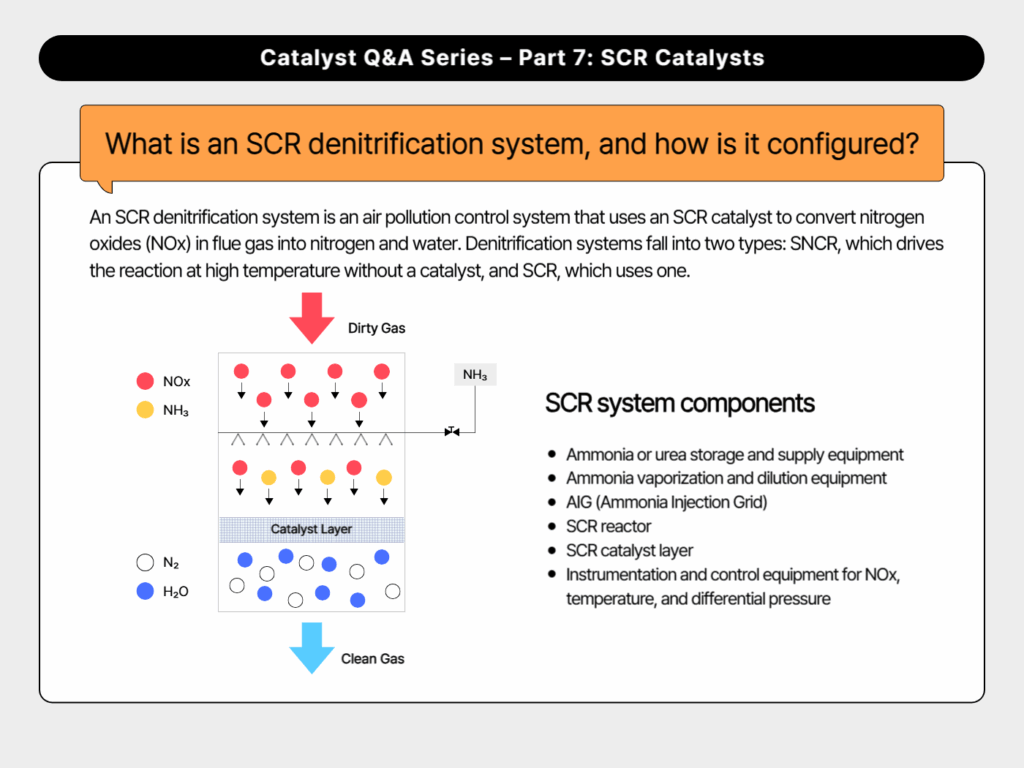
An SCR denitrification system is an air pollution control system that uses an SCR catalyst to convert nitrogen oxides (NOx) in flue gas into nitrogen and water. Denitrification systems fall into two types: SNCR, which drives the reaction at high temperature without a catalyst, and SCR, which uses one.
*SNCR (Selective Non-Catalytic Reduction): reduces NOx at high temperature without a catalyst
*SCR (Selective Catalytic Reduction): reduces NOx using a catalyst
SCR system components
- Ammonia or urea storage and supply equipment
- Ammonia vaporization and dilution equipment
- AIG (Ammonia Injection Grid)
- SCR reactor
- SCR catalyst layer
- Instrumentation and control equipment for NOx, temperature, and differential pressure
The AIG injects an ammonia-based reductant into the flue gas. Once that reductant mixes thoroughly with the gas and passes through the catalyst layer, the NOx converts into nitrogen and water.
Representative SCR reaction
4NH₃ + 4NO + O₂ → 4N₂ + 6H₂O
In this reaction, nitric oxide (NO) and ammonia (NH₃) react at roughly a 1:1 molar ratio. In practice, though, the ammonia dosing rate has to account for the proportion of nitrogen dioxide (NO₂), the flue gas flow rate, temperature, and catalyst activity. Injection uniformity at the AIG matters here: only when ammonia mixes evenly with the flue gas can the entire catalyst layer deliver consistent NOx conversion and stable NH₃ slip control.
Reliable denitrification performance therefore depends not only on the SCR catalyst but on the AIG’s injection uniformity, the flue gas flow, conditions inside the reactor, and the control system working together.


2. What types of SCR catalysts are there?
SCR catalysts can be classified by active component and raw material, and by physical shape.
① By active component and raw material
Vanadia-based
Industrial SCR catalysts commonly use titania (TiO₂) as the support and vanadium oxide (V₂O₅) as the active component. Depending on operating conditions, tungsten oxide (WO₃) or molybdenum oxide (MoO₃) may be added to reinforce thermal stability, mechanical properties, and resistance in environments containing sulfur oxides (SOx).
Vanadia-based catalysts have a long track record at stationary sources such as power plants, industrial boilers, and incinerators. The literature generally evaluates their activity in the range of roughly 250–450°C, though the actual working temperature shifts with composition and flue gas conditions.
Zeolite-based
Metal-loaded zeolite materials such as copper zeolite (Cu-zeolite) and iron zeolite (Fe-zeolite) are also used in NH₃-SCR reactions. Copper zeolite tends to reach high activity at relatively low temperatures, while iron zeolite performs better in higher-temperature ranges. These materials see frequent use in applications with wide temperature swings, such as automotive and gas engine exhaust, where sulfur, moisture, flue gas temperature, and long-term durability all warrant close attention.
Other metal-oxide types
Research continues on low-temperature SCR materials based on manganese, cerium, and iron. The goal is to remove NOx even at low flue gas temperatures, but commercialization calls for verifying performance loss from SOx and moisture, long-term durability, and productivity at commercial scale.
Factors to weigh when selecting a catalyst
- Average, minimum, and maximum flue gas temperature
- Ratio of NO to NO₂
- SOx and moisture concentration
- Dust and alkali metal content
- Flue gas flow rate and space velocity
- Startup, shutdown, and load variation
- Target NOx removal rate
- Required level of NH₃ slip control
② By physical shape
SCR catalysts generally take honeycomb, plate, or corrugated form. Because shape affects reaction area, pressure loss, dust tolerance, and mechanical durability, the right form depends on dust concentration, flue gas flow, allowable differential pressure, and the available installation and maintenance space.
Honeycomb
A monolithic structure of straight, honeycomb-shaped channels. It secures a relatively large reaction area within a given volume, and because the flue gas flows straight along the channels, it lends itself to a low-pressure-loss design. Tighter channels widen the reaction area, but in dusty processes they raise the risk of clogging and rising differential pressure. Cleaner streams such as gas engine exhaust can use smaller channels, while dust-heavy sources like coal-fired plants and incinerators call for larger ones.
Plate
Catalyst material is applied to metal plates or mesh, which are then stacked at regular intervals. The high mechanical strength and wide gas passages suit dust-laden flue gas. The trade-off is that the reaction area within a given installation volume is smaller than a honeycomb’s, so the required loading and reactor space need to be checked.
Corrugated
Thin ceramic-paper or glass-fiber sheets are corrugated, then layered with flat sheets or rolled to form gas passages. The thin substrate makes it easy to achieve a high open area and a wide reaction area, and the modules stay comparatively light. Points to verify include adhesion between the substrate and coating layer, thermal stability, and durability against moisture and vibration.
3. What is the ideal operating temperature for an SCR catalyst?
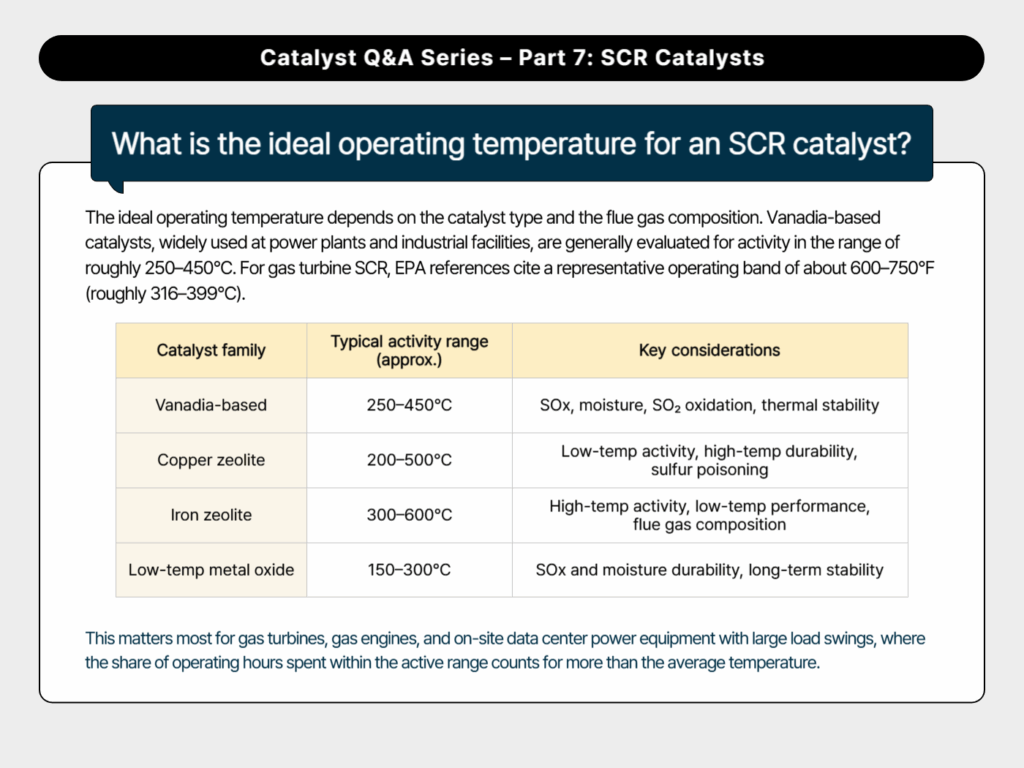
The ideal operating temperature depends on the catalyst type and the flue gas composition. Vanadia-based catalysts, widely used at power plants and industrial facilities, are generally evaluated for activity in the range of roughly 250–450°C. For gas turbine SCR, EPA references cite a representative operating band of about 600–750°F (roughly 316–399°C).
| Catalyst family | Typical activity range (approx.) | Key considerations |
| Vanadia-based | 250–450°C | SOx, moisture, SO₂ oxidation, thermal stability |
| Copper zeolite | 200–500°C | Low-temp activity, high-temp durability, sulfur poisoning |
| Iron zeolite | 300–600°C | High-temp activity, low-temp performance, flue gas composition |
| Low-temp metal oxide | 150–300°C | SOx and moisture durability, long-term stability |
These figures reflect the temperature ranges commonly cited in industry and the literature. Even within one family, actual performance varies with composition and flue gas characteristics. When the temperature runs too low, the reaction slows, NOx removal drops, and unreacted ammonia escapes downstream; where SOx is present, ammonium sulfate salts can form and accumulate in the reactor or downstream equipment. When it runs too high, ammonia oxidizes instead of reducing NOx, and the catalyst components degrade faster.
This matters most for gas turbines, gas engines, and on-site data center power equipment with large load swings, where the share of operating hours spent within the active range counts for more than the average temperature.
4. What’s the difference between SNCR and SCR?
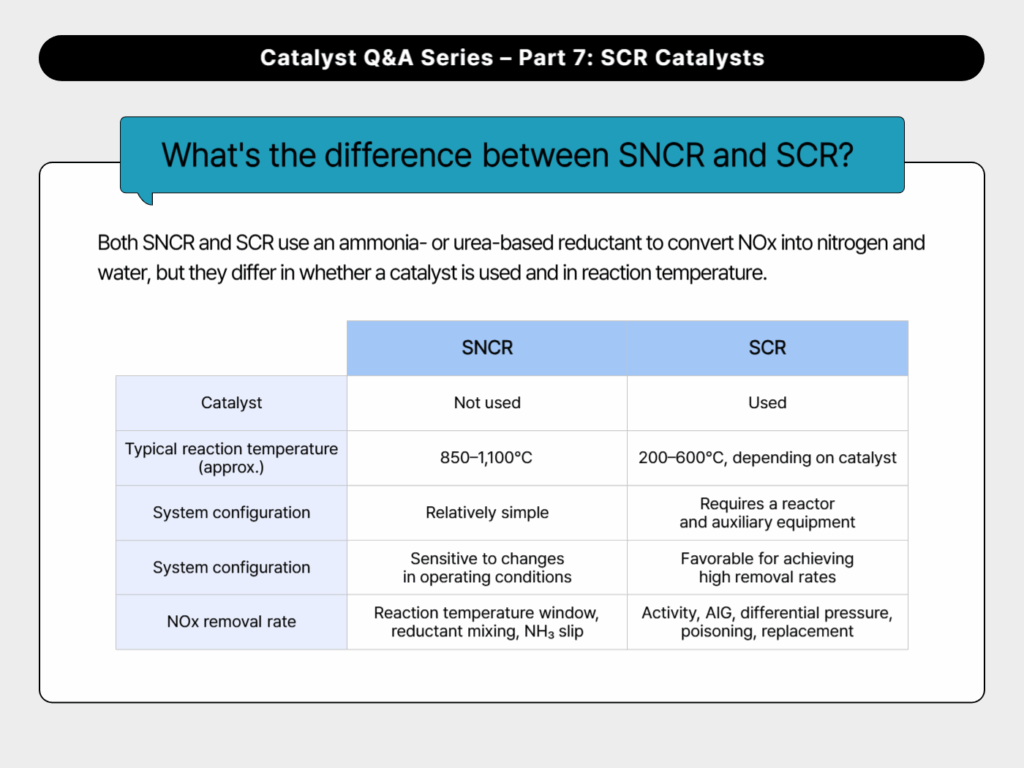
Both SNCR and SCR use an ammonia- or urea-based reductant to convert NOx into nitrogen and water, but they differ in whether a catalyst is used and in reaction temperature.
| Category | SNCR | SCR |
| Catalyst | Not used | Used |
| Typical reaction temperature (approx.) | 850–1,100°C | 200–600°C, depending on catalyst |
| System configuration | Relatively simple | Requires a reactor and auxiliary equipment |
| System configuration | Sensitive to changes in operating conditions | Favorable for achieving high removal rates |
| NOx removal rate | Reaction temperature window, reductant mixing, NH₃ slip | Activity, AIG, differential pressure, poisoning, replacement |
SNCR injects the reductant directly into high-temperature combustion gas. The configuration is relatively simple, but the workable temperature window is narrow: run too cool and NH₃ slip rises, run too hot and the ammonia oxidizes. SCR uses a catalyst to remove NOx at comparatively lower temperatures. It generally favors high removal rates, though actual performance hinges on flue gas temperature, inlet NOx concentration, catalyst condition, and ammonia injection uniformity.
The right choice comes from weighing the required removal level, operating conditions, installation space, and system configuration together. Where it helps, the two methods can be combined.


5. What determines SCR denitrification performance?
SCR’s NOx reduction performance is never settled by a single factor. Five, in particular, work in combination.
(1) Flue gas temperature
Once the temperature leaves the active range, NOx removal falls off. At low temperatures the reaction slows and the risk of NH₃ slip and ammonium sulfate deposition rises; at high temperatures, ammonia oxidation and catalyst degradation come into play.
(2) NH₃/NOx ratio
In the main SCR reaction, NH₃ and NO react at roughly a 1:1 molar ratio. Too little reductant makes the target removal rate hard to reach; too much sends unreacted ammonia downstream. Some EPA technical references describe cases that applied an NH₃/NOx molar ratio of 1.05–1.1 when targeting about 80–90% NOx conversion, though the real dosing ratio shifts with the NO₂ proportion, catalyst condition, and target slip level.
(3) AIG injection and mixing uniformity
Raising the ammonia dose does not raise NOx removal on its own. If injection volume varies from nozzle to nozzle or the mixing distance falls short, the NH₃/NOx ratio ahead of the catalyst layer turns uneven, so the correct dose has to reach the right locations evenly, matched to the inlet NOx concentration.
(4) Flue gas flow distribution
Where gas concentrates in one part of the catalyst layer, space velocity climbs there and reaction time runs short; where flow is light, ammonia is supplied in relative excess. CFD is often used here to examine the flow and ammonia concentration distribution inside the reactor in advance.
*CFD(Computational Fluid Dynamics)
(5) Catalyst condition
Over long-term operation, performance degrades through:
- Poisoning by sulfur, arsenic, alkali metals, and the like
- Clogging from dust and ammonium sulfate salts
- Degradation of active components
- Erosion and abrasion
- Cracking and physical damage
- Rising differential pressure across the catalyst layer
Stable operation means managing inlet and outlet NOx concentration, ammonia dosing, NH₃ slip, catalyst layer temperature, differential pressure, and load history together.
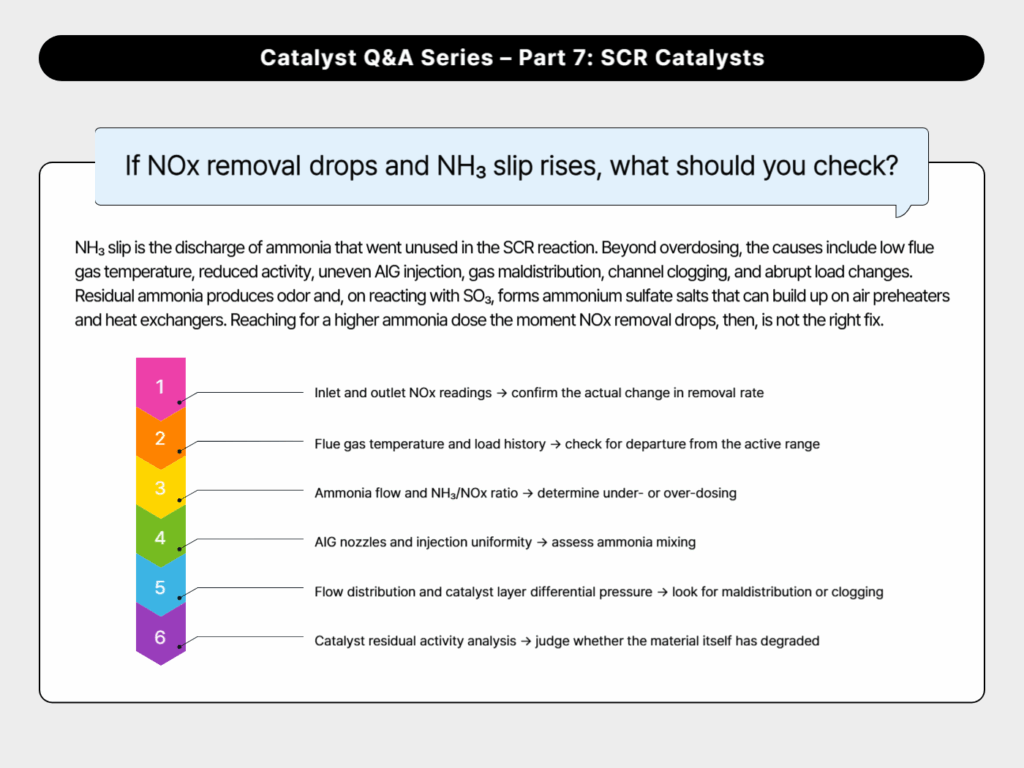
6. If NOx removal drops and NH₃ slip rises, what should you check?
NH₃ slip is the discharge of ammonia that went unused in the SCR reaction. Beyond overdosing, the causes include low flue gas temperature, reduced activity, uneven AIG injection, gas maldistribution, channel clogging, and abrupt load changes. Residual ammonia produces odor and, on reacting with SO₃, forms ammonium sulfate salts that can build up on air preheaters and heat exchangers. Reaching for a higher ammonia dose the moment NOx removal drops, then, is not the right fix.
Diagnostic sequence
Step 1: Inlet and outlet NOx readings → confirm the actual change in removal rate
Step 2: Flue gas temperature and load history → check for departure from the active range
Step 3: Ammonia flow and NH₃/NOx ratio → determine under- or over-dosing
Step 4: AIG nozzles and injection uniformity → assess ammonia mixing
Step 5: Flow distribution and catalyst layer differential pressure → look for maldistribution or clogging
Step 6: Catalyst residual activity analysis → judge whether the material itself has degraded
If NH₃ slip persists after operating conditions are improved, the next steps are to reinforce or replace the SCR catalyst and consider a downstream Hybrid catalyst. That said, a Hybrid catalyst is a supplementary measure for reducing residual ammonia, so AIG unevenness or serious loss of SCR catalyst activity has to be addressed at the root first.
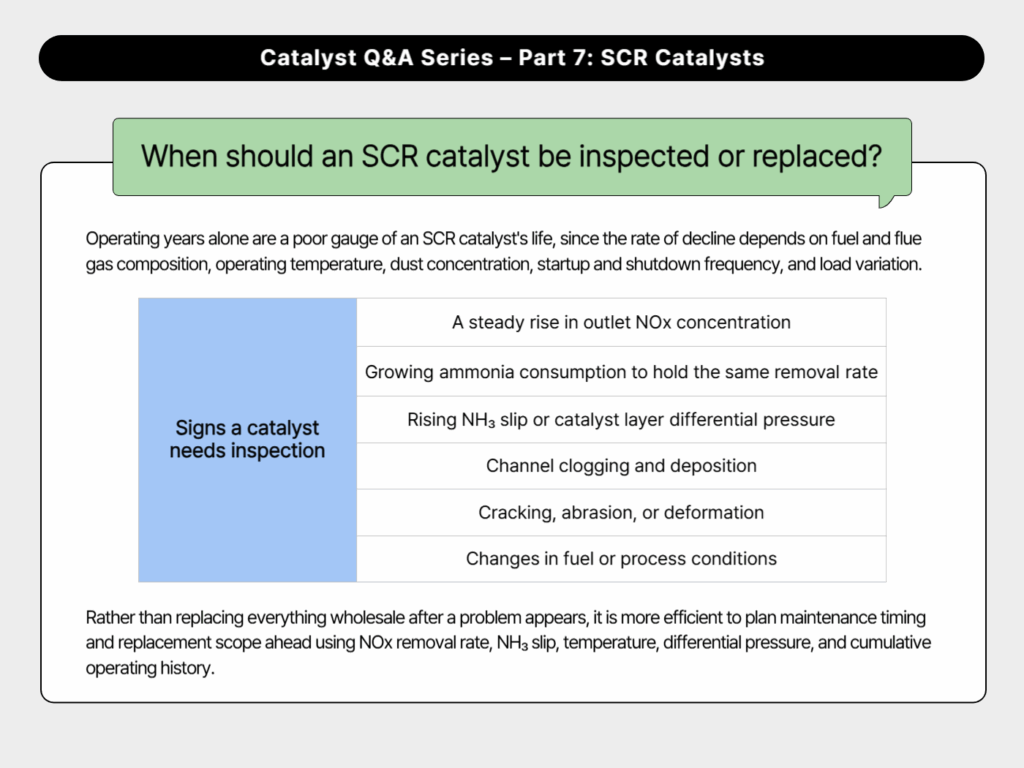
7. When should an SCR catalyst be inspected or replaced?
Operating years alone are a poor gauge of an SCR catalyst’s life, since the rate of decline depends on fuel and flue gas composition, operating temperature, dust concentration, startup and shutdown frequency, and load variation.
Signs a catalyst needs inspection
- A steady rise in outlet NOx concentration
- Growing ammonia consumption to hold the same removal rate
- Rising NH₃ slip or catalyst layer differential pressure
- Channel clogging and deposition
- Cracking, abrasion, or deformation
- Changes in fuel or process conditions
Replacement is judged from operating data, physical condition, and residual activity taken together. If a sample taken on-site still shows sufficient activity, cleaning, repositioning, or partial reinforcement can address the issue. Where activity falls below the required level or physical damage is severe, replacement warrants consideration. Rather than replacing everything wholesale after a problem appears, it is more efficient to plan maintenance timing and replacement scope ahead using NOx removal rate, NH₃ slip, temperature, differential pressure, and cumulative operating history.
Managing NOx removal performance across the catalyst and the denitrification system
The performance of an SCR denitrification system cannot be judged by its initial NOx removal rate alone. Stable performance comes from managing the whole picture, from ammonia injection at the AIG through flue gas composition to catalyst condition. In particular, simply increasing the ammonia dose when NOx removal drops can drive up both NH₃ slip and operating costs. Pinpointing the cause means treating the AIG, SCR reactor, catalyst layer, and control system as one denitrification system and diagnosing them together.
Heesung Catalysts designs SCR catalysts around the operating conditions of power plants and industrial facilities, and ensures stable NOx reduction performance through CFD-based flow and reaction modeling and activity evaluation under real flue gas conditions. We also provide Hybrid catalyst solutions that manage residual ammonia downstream of the SCR, supporting a wide range of emission sources.
References
[1] U.S. Environmental Protection Agency, Control of NOx Emissions from U.S. Coal-Fired Electric Utility Boilers.
[2] U.S. Environmental Protection Agency, Combustion Turbine NOx Control Technology Memo, 2022.
[3] U.S. Environmental Protection Agency, Air Pollution Control Technology Fact Sheet: Selective Catalytic Reduction.
※ Figures in this article represent general ranges or individual application cases cited in the literature and public sources. Actual performance varies with fuel, flue gas composition, system design, catalyst specification, space velocity, and operating conditions.
➡️ Catalyst Q&A Series
- Catalyst Q&A Series – Part 1. Why Are Catalysts Important?
- Catalyst Q&A Series – Part 2. The Role of Catalysts in a Carbon-Neutral, Hydrogen-Powered Future
- Catalyst Q&A Series – Part 3. Criteria for Selecting Industrial Catalysts
- Catalyst Q&A Series – Part 4. Applications of Catalysts in Major Industries (1)
- Catalyst Q&A Series – Part 5. Applications of Catalysts in Major Industries (2)
- Catalyst Q&A Series – Part 6. Catalyst vs. Catalysis: What’s the Difference?
