

Carbon-supported Precious Metal Catalysts: Industrial Applications and Core Design Technologies
2026.08.12
Key Takeaways
- How carbon-supported precious metal catalyst work: a structure that pairs the high catalytic activity of precious metals with the large surface area and electrical conductivity of carbon
- Key industrial applications across chemical and fine chemical processes, fuel cells, and water electrolysis
- The core design factors that determine performance, including precious metal particle size and dispersion, carbon pore structure and surface properties, and manufacturing conditions
What Is a Carbon-supported Precious Metal Catalyst?
A carbon-supported precious metal catalyst uses a precious metal as the active material and carbon as the support. It works across a wide range of industries, from manufacturing everyday chemical products to hydrogen fuel cells, a technology drawing attention as part of the future energy landscape.
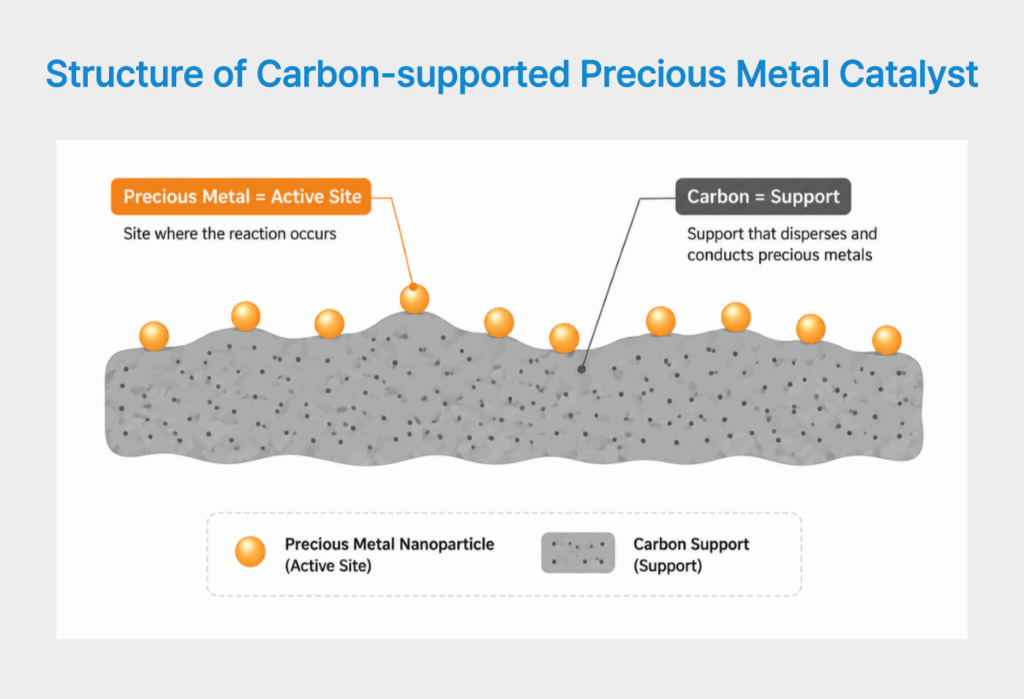
Precious metals offer high catalytic activity, driving many chemical reactions at speed. Used in bulk form, however, they expose only a limited surface area to the reaction, which makes it hard to use these costly materials efficiently. To get past that limit, we break precious metals into fine particles and spread them evenly across a support with a large surface area. Carbon serves as the leading support here, thanks to its high specific surface area, varied pore structures, and excellent electrical conductivity.
What Do the Precious Metal and Carbon Each Do?
The precious metal serves as the active site where the chemical reaction actually takes place. Reactants adsorb onto the metal surface, and the target reaction proceeds as specific bonds break or new ones form. Palladium (Pd), platinum (Pt), ruthenium (Ru), and rhodium (Rh) each adsorb reactants with different strengths and favor different bonds, so the right metal has to be matched to the target product and reaction conditions.
Carbon does more than support the precious metal. With its high specific surface area, pores of varying size, and electrical conductivity, it spreads the metal particles widely and holds them firmly in place. The pore structure becomes the path along which reactants and products travel, and in electrochemical reactions such as those in fuel cells, it forms the route that carries electrons.
In short, the precious metal provides the active sites that drive the reaction, while carbon disperses the metal effectively and creates the structure and environment through which reactants and electrons move.
Industrial Applications of Carbon-supported Precious Metal Catalysts
Carbon-supported precious metal catalysts work across industries that rely on hydrogenation, oxidation, and electrochemical reactions.
Securing conversion and selectivity in chemical and fine chemical reactions
One representative case is the hydrogenation of nitrobenzene to produce aniline. Here, the goal is to convert enough of the feedstock into the target product while suppressing intermediates and byproducts to keep selectivity high. Meeting that goal means considering the type of precious metal, its particle form, the carbon pore structure, and the operating conditions together.
Precise catalyst design matters just as much in producing pharmaceutical intermediates and fine chemicals, where only specific bonds should react to yield the desired compound. Even with the same Pd/C catalyst, the actual outcome shifts with precious metal loading, particle size and distribution, and the surface properties of the carbon.
Promoting electrode reactions in fuel cells and water electrolysis
In the energy sector, platinum-based catalysts such as Pt/C, Pt-Co/C, Pt-Ni/C, and Pt-Ru/C serve as the leading electrode catalysts in polymer electrolyte membrane fuel cells (PEMFC). Platinum drives the hydrogen oxidation reaction (HOR) and the oxygen reduction reaction (ORR), while carbon disperses the platinum particles evenly and provides the path for electrons to travel. This calls for securing precious metal utilization, electrochemically active surface area (ECSA), conductivity, resistance to particle agglomeration, and long-term durability all at once.
Carbon-supported precious metal catalysts play a major role in water electrolysis as well. Pt/C leads the way in the hydrogen evolution reaction (HER), while iridium- and ruthenium-based oxide catalysts such as IrO₂ and RuO₂ handle the oxygen evolution reaction (OER).
Factors That Determine Carbon-supported Precious Metal Catalyst Performance
The performance of a carbon-supported precious metal catalyst depends less on how much precious metal it contains than on how effectively it forms and maintains the active sites that matter. In practice, the same precious metal at the same loading can perform differently. How much of the precious metal actually contributes to the reaction is decided by the interplay of metal particle size and dispersion, carbon pore structure and surface properties, and the manufacturing and reduction conditions.
Particle size and dispersion
Dispersing precious metal particles finely and uniformly secures more surface active sites from the same amount of metal, which matters for using costly precious metals efficiently.
Smaller particles do not always make a better catalyst, though. Depending on the reaction, particles or crystal faces of a certain size can deliver higher selectivity, and particles that are too small tend to clump together through sintering during high-temperature or long-duration operation.
Catalyst design therefore aims less at making particles small than at realizing the particle size and structure suited to the target reaction and keeping them stable.
Pore structure and surface properties
A high specific surface area helps carbon disperse precious metals widely, but surface area alone is not enough. If the pores are too small, larger reactant molecules struggle to reach the interior of the catalyst, and diffusion resistance builds up as products make their way out. In liquid-phase hydrogenation especially, the pore structure has to be designed so reactants and solvent move smoothly into the catalyst.
The oxygen functional groups and chemical properties of the carbon surface also shape how the precious metal precursor interacts with the surface and how metal particles nucleate. The right surface functional groups help fix the metal uniformly, but excessive surface treatment can instead lower the conductivity and stability of the carbon. Achieving the intended metal dispersion and catalyst performance therefore calls for tuning the carbon surface appropriately.
Manufacturing process and reproducibility
Catalyst performance also shifts during manufacturing. The position, size, and distribution of precious metal particles depend on the method, whether impregnation, precipitation, or reduction. The type of metal precursor, the pH of the solution, the reduction temperature and rate, and the washing and drying conditions all shape the final catalyst’s characteristics.
The same Pd 5 wt% catalyst, for instance, can end up with a different proportion of active surface metal, selectivity, and long-term stability once the manufacturing conditions change.
High initial activity confirmed in the lab is not enough for the field. It has to be backed by the manufacturing technology and quality control needed to reproduce the same characteristics and performance reliably, even as production scales up.
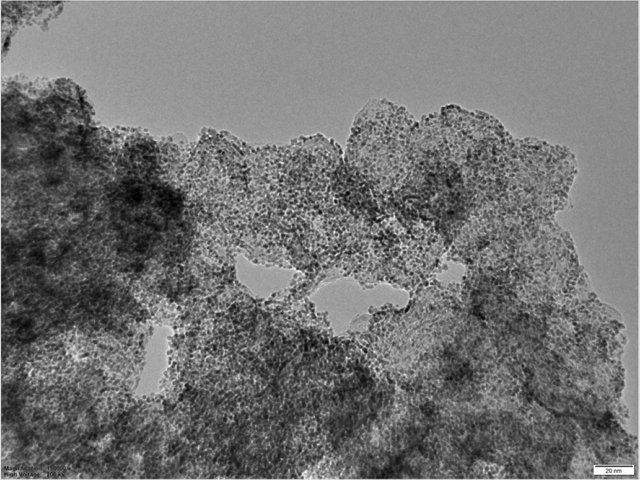
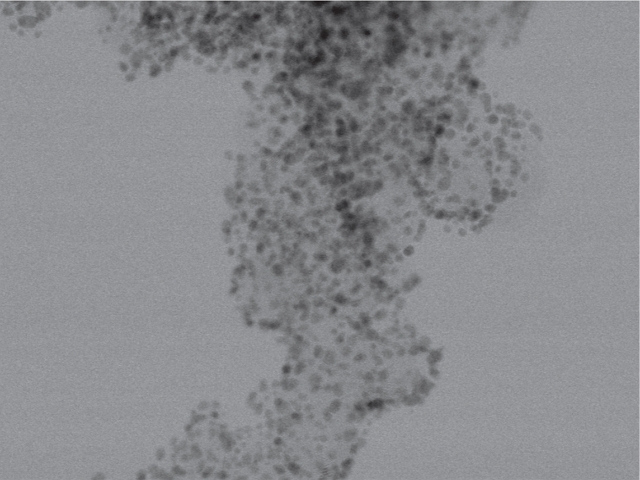
Figure 2,3. TEM image of a carbon-supported precious metal catalyst
Latest Technology Trends in Carbon-supported Precious Metal Catalysts
Recent development of carbon-supported precious metal catalyst moves toward securing high activity and durability while cutting the amount of precious metal used. Active research raises catalyst utilization by dispersing precious metal particles uniformly, or lifts both performance and durability by applying alloy catalysts such as Pt-Pd and Pt-Ru. Techniques that improve electrical conductivity and structural stability with new carbon supports such as CNTs and graphene are drawing attention as well.
Carbon can carry more than precious metals as active materials, including non-precious metals such as nickel (Ni), cobalt (Co), iron (Fe), and copper (Cu), along with metal oxides. How the metal and support are combined to suit the purpose of the reaction lies at the heart of catalyst design, and expanding those combinations leads toward next-generation catalyst technology. Single-atom catalysts, metal-nitrogen-carbon (M–N–C) structures, and metal oxide-carbon composites are representative examples.
The Value of a Catalyst Comes Together in Design and Realization
The performance of a carbon-supported precious metal catalyst rests less on the material itself than on the design technology behind it, including the choice of active material and support, the size and distribution of metal particles, and manufacturing stability.
At Heesung Catalysts, we research and develop a wide range of materials and support technologies, covering non-precious as well as precious metal catalysts. To raise catalytic activity and durability in particular, we advance our catalyst design capabilities by considering metal particle dispersion, support structure and surface properties, and manufacturing conditions together. We do not stop at lab-scale development. Building on manufacturing capabilities that connect mass production, quality control, and scale-up, we will widen the range of industries our catalysts serve.

FAQ
Q1. What is a carbon-supported precious metal catalyst?
It is a catalyst that uses a precious metal as the active material and carbon as the support. The precious metal drives the chemical reaction, while carbon disperses and fixes the metal particles widely and provides an environment through which reactants and electrons move.
Q2. What role does carbon play in a carbon-supported precious metal catalyst?
Carbon uses its high specific surface area and pore structure to disperse precious metal particles uniformly and hold them firmly in place. Its high electrical conductivity also forms the path that carries electrons in electrochemical reactions such as those in fuel cells.
Q3. What determines the performance of a carbon-supported precious metal catalyst?
The main factors are metal particle size and dispersion, carbon pore structure and surface properties, and the manufacturing and reduction conditions. Even at the same precious metal loading, activity, selectivity, and durability can vary with these conditions.
Q4. Where are carbon-supported precious metal catalysts used?
They work across industries, from hydrogenation and oxidation in chemical and fine chemical fields to electrode reactions in hydrogen fuel cells and water electrolysis. Platinum-based catalysts such as Pt/C, Pt-Co/C, Pt-Ni/C, and Pt-Ru/C serve as electrode catalysts in PEMFCs, and Pt/C is also used in the hydrogen evolution reaction (HER) of water electrolysis.
Q5. Can catalyst performance improve while reducing precious metal use?
Yes. Dispersing precious metal particles uniformly to secure more surface active sites, or applying alloy catalysts such as Pt-Pd and Pt-Ru, raises both precious metal utilization and catalyst performance. Recently, the range of materials and design has widened further with single-atom catalysts, M–N–C structures, and metal oxide-carbon composites.
