

Ammonia Cracking for Clean Hydrogen Power : Heesung Catalysts MOU
2026.06.12
Hydrogen storage and transportation remain key challenges for expanding clean hydrogen power generation. Compressed hydrogen generally requires high-pressure storage at 350–700 bar, while liquid hydrogen requires cryogenic conditions of around -252.8°C. In contrast, ammonia can be liquefied at approximately -33°C under atmospheric pressure or at around 10 bar at room temperature, making it a promising hydrogen carrier for large-scale storage and transportation.
Ammonia cracking is a technology that converts ammonia into hydrogen. As a supply chain technology connecting hydrogen production sites with end users, it is expected to play an important role in the future of clean hydrogen power generation.
Why Ammonia Cracking Matters for Clean Hydrogen Power Generation
Clean hydrogen is gaining attention as a core energy source for future energy systems, but direct hydrogen distribution still faces practical limitations. Hydrogen has low volumetric density, requires specialized storage systems, and often depends on high-pressure or cryogenic infrastructure.
Ammonia offers a different route. As a hydrogen carrier, ammonia can store and transport hydrogen at scale using comparatively mature handling and logistics infrastructure. Ammonia cracking technology converts ammonia into hydrogen, enabling hydrogen to be produced closer to the point of use.
For power generation, this is particularly important. A stable ammonia-to-hydrogen pathway can help connect clean hydrogen production sites with power generation assets, supporting future clean hydrogen power systems.
The Role of Catalyst Technology
In an ammonia cracking system, catalysts are key components that determine hydrogen production efficiency and reaction stability. Catalyst performance can affect ammonia conversion, operating stability, and overall system efficiency.
In clean hydrogen power generation systems, emissions control during power generation is also important, in addition to hydrogen production. While ammonia cracking catalysts improve hydrogen production efficiency, environmental catalysts can contribute to reducing emissions and improving system performance during power generation.
Based on its accumulated expertise in chemical catalysts and environmental catalysts, Heesung Catalysts plans to participate in the development of catalyst solutions for clean hydrogen power generation.
MOU for Clean Hydrogen Power Generation Ammonia Cracking System Development
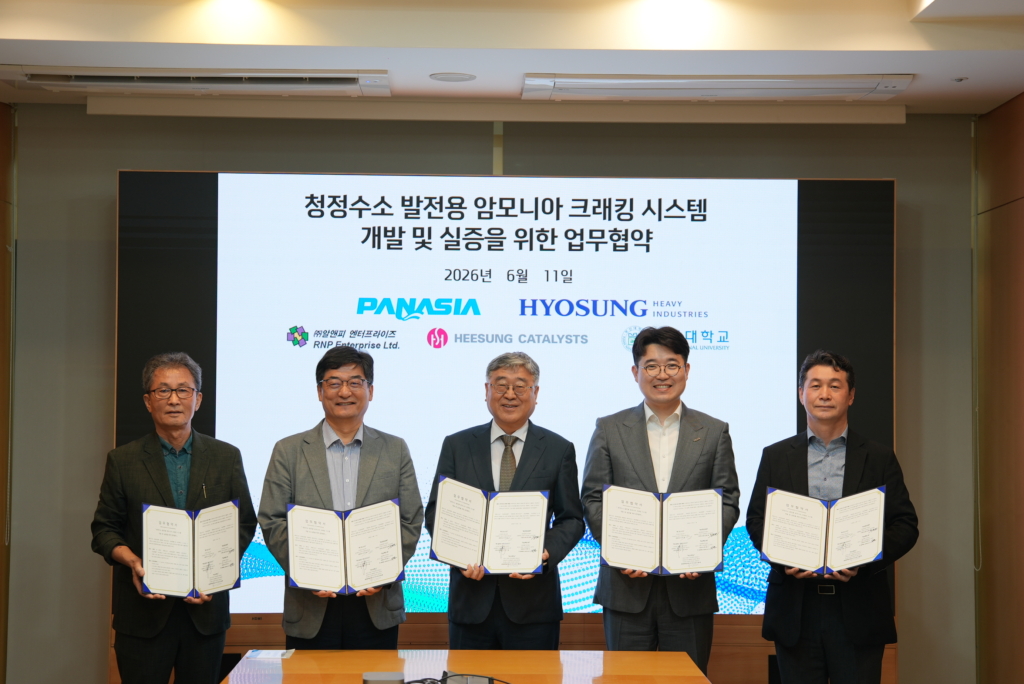
On June 11, 2026, Heesung Catalysts signed a Memorandum of Understanding with the Clean Thermal Power Generation Energy Research Institute at Pusan National University, Panasia, Hyosung Heavy Industries, and RNP Enterprise for the development and demonstration of an ammonia cracking system for clean hydrogen power generation.
The agreement aims to advance clean hydrogen production technologies using ammonia, expand their application in the power generation sector, and establish a collaborative framework for technology demonstration and commercialization.
The Clean Thermal Power Generation Energy Research Institute at Pusan National University will support related research and industry-academia collaboration. Panasia, Hyosung Heavy Industries, RNP Enterprise, and Heesung Catalysts will participate in system development and demonstration by contributing their respective technical expertise.
Through this collaboration, the participating organizations plan to connect clean hydrogen production, power generation, and emissions control technologies, while expanding future domestic and global business opportunities and strengthening technological competitiveness.
Heesung Catalysts will continue to contribute to the advancement of clean hydrogen production and utilization technologies as a catalyst technology company and expand catalyst-based solutions that support customers in their energy transition efforts.
Prepared by Marketing Team, Heesung Catalysts
References
[1] International Energy Agency, The Future of Hydrogen
[2] U.S. Department of Energy, Hydrogen Storage
[3] IRENA, Reports on Global Hydrogen Trade and Ammonia as a Hydrogen Carrier
