

Next-Generation Aviation Fuel: e-SAF Finds Its Answer in e-Methanol
2026.06.17
As pressure mounts on the aviation industry to achieve carbon neutrality, interest in Sustainable Aviation Fuel (SAF) is growing rapidly. The International Civil Aviation Organization (ICAO) has identified SAF as a key pathway to reaching net-zero emissions by 2050, and the European Union is steadily increasing the mandatory SAF blending ratio under its ReFuelEU Aviation policy. Airlines and energy companies worldwide are responding by investing in production facilities and securing supply chains.
The dominant production method in today’s SAF market is the HEFA (Hydroprocessed Esters and Fatty Acids) process, which uses waste cooking oil and animal fats as feedstocks. While HEFA is the most widely adopted approach, the limited availability of these feedstocks raises questions about whether supply can keep pace with long-term aviation fuel demand.
e-SAF: A Way Forward in the Feedstock Competition
Against this backdrop, e-SAF has emerged as a compelling alternative. e-SAF(e-Sustainable Aviation Fuel) is a synthetic aviation fuel produced using green hydrogen generated from renewable energy and carbon dioxide captured from industrial processes or the atmosphere. Unlike conventional SAF, which relies on bio-based feedstocks such as waste cooking oil or biomass, e-SAF’s defining characteristic is its use of electricity and CO2 as primary inputs.
Because e-SAF recycles emitted carbon back into fuel production, it also holds meaningful promise from a carbon circularity standpoint. Compared to conventional SAF constrained by limited feedstock availability, e-SAF offers the potential for a more stable and scalable long-term production system.
Challenges remain, however, including establishing the economic viability of hydrogen and CO2-based fuel production and building out the necessary infrastructure. Despite this, the aviation industry is actively evaluating e-SAF as a leading next-generation fuel option, with projects and investment expanding particularly in Europe and North America.
MTJ and e-Methanol
Given the limitations of biofuels, a range of SAF production pathways beyond HEFA are under consideration, including FT (Fischer-Tropsch), ATJ (Alcohol-to-Jet), and MTJ (Methanol-to-Jet), each differentiated by feedstock and process. Interest in synthetic fuel production technologies capable of utilizing CO2 and renewable hydrogen has grown considerably in recent years.
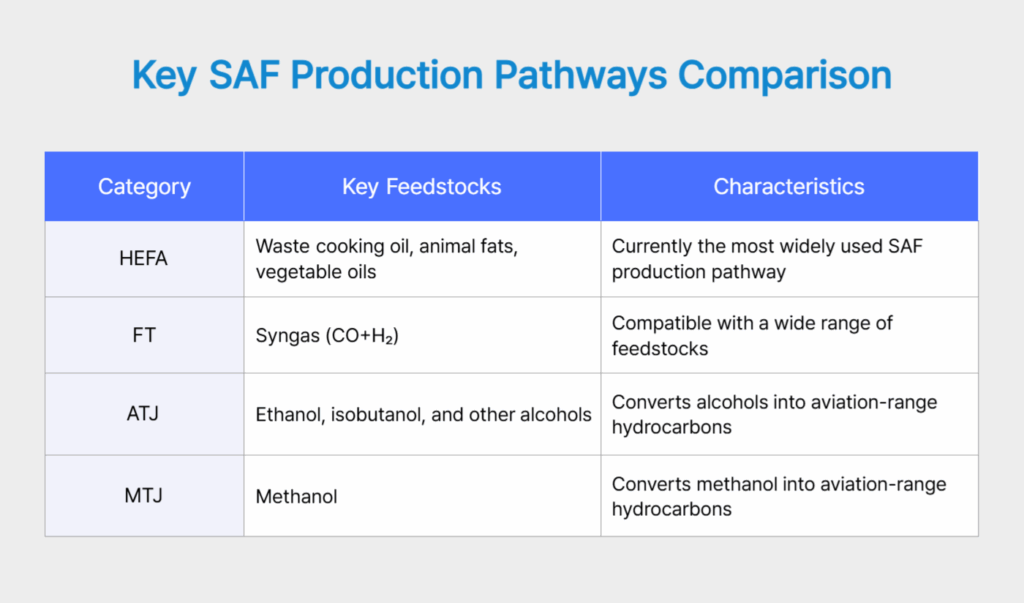
Among these, MTJ converts methanol into aviation-range hydrocarbons. When combined with e-Methanol, this pathway enables the production of carbon-neutral aviation fuel.
e-Methanol is produced by reacting captured CO2 with green hydrogen derived from renewable energy. It remains liquid at ambient temperature, allowing it to be stored and transported using existing fuel infrastructure, and unlike hydrogen, it requires no high-pressure or cryogenic equipment.

Catalyst Performance Determines e-Methanol Competitiveness
The competitiveness of e-Methanol production ultimately depends on how efficiently CO2 can be converted into methanol. Even with identical feedstocks and equipment, catalyst performance directly determines both the CO2 conversion rate and methanol yield. How consistently a catalyst maintains its performance over extended operation also has a significant impact on economic viability.
When evaluating methanol synthesis catalysts, it is therefore important to consider not only high CO2 conversion rates and methanol selectivity, but also long-term durability and scalability for industrial-scale production. As e-Methanol projects advance toward commercialization, the ability to replicate laboratory-level performance in real production environments has become a critical competitive factor.
In short, a truly effective methanol synthesis catalyst is one that delivers high efficiency and stability not just at the lab scale, but at industrial scale as well.
Heesung Catalysts: Developing Catalysts for CCU-Based Methanol Synthesis
Heesung Catalysts is actively developing methanol synthesis catalyst technologies for carbon-neutral fuel production. At the 2025 Spring Conference of the Korean Society for Energy and Climate Change, the company presented research titled “Development and Mass Production of Methanol Synthesis Catalysts for Carbon-Neutral Fuel Production,” receiving the Outstanding Paper Presentation Award.
The research focuses on CCU (Carbon Capture and Utilization)-based methanol production, featuring a co-precipitation-derived Cu/Zn/Al catalyst with an optimized precursor composition for enhanced catalytic activity. The introduction of zirconium creates oxygen vacancies on the catalyst surface, improving CO2 adsorption and activation and enabling strong CO2 conversion rates and methanol selectivity even under moderate temperature conditions. The catalyst also demonstrated consistent performance at industrial-scale production, confirming its commercial viability.
Heesung Catalysts also featured its methanol synthesis catalyst as a key exhibit at ISCRE29 & APCRE11 in 2026. The event generated sustained interest in methanol production technology and carbon-neutral fuel solutions, reflecting growing industrial demand for CO2 utilization-based processes.
Turning Carbon into Fuel
The SAF market is currently growing around HEFA, but feedstock diversification and carbon-circularity fuel systems are expected to become increasingly important over the long term. Within this shift, e-Methanol is gaining recognition as a critical intermediate for e-SAF production, and methanol synthesis catalysts are emerging as the core technology that determines production efficiency and economic competitiveness.
Heesung Catalysts will continue to leverage its capabilities in catalyst design, manufacturing, and mass production to navigate the evolving e-Methanol and e-SAF landscape and contribute to a sustainable energy transition.

FAQ
Q1. What is e-SAF?
e-SAF is a synthetic aviation fuel produced using green hydrogen generated from renewable electricity and captured CO2. Because it uses electricity and CO2 as feedstocks in place of fossil fuels, it can significantly reduce carbon emissions across its entire production lifecycle.
Q2. How does e-SAF differ from conventional SAF?
Conventional SAF is typically produced from bio-based feedstocks such as waste cooking oil, animal fats, or biomass. e-SAF, by contrast, uses renewable hydrogen and captured CO2 as its primary inputs. This approach overcomes the constraints of bio-based feedstock supply and enables a carbon-circularity fuel system in which CO2 is treated as a resource rather than a waste product.
Q3. How is e-Methanol produced?
e-Methanol is produced by reacting captured CO2 with green hydrogen. In this process, the methanol synthesis catalyst activates CO2 and converts it into methanol. The resulting e-Methanol can be used in the shipping industry or as a chemical feedstock, and can also serve as a precursor for e-SAF production through the MTJ process.
Q4. Why are methanol synthesis catalysts so important?
Methanol synthesis catalysts are the core technology determining the efficiency and economic viability of converting CO2 and hydrogen into methanol. Because CO2 is a chemically stable molecule, efficient conversion without a catalyst is extremely difficult. High CO2 conversion rates, methanol selectivity, and long-term durability are therefore critical performance requirements. As e-Methanol production scales up, catalyst performance will have a direct bearing on production costs, process stability, and the feasibility of commercialization.
