


Methane Management in Industry: Strategies and Technologies for a High-Impact Greenhouse Gas
2026.05.26
Methane (CH₄) ranks as the second most potent greenhouse gas after carbon dioxide. It stays in the atmosphere for roughly 12 years — a shorter lifespan than CO₂ — but during that time, it traps far more heat per molecule, driving a disproportionately strong warming effect. That is precisely why methane management has become one of the most pressing fronts in climate action.
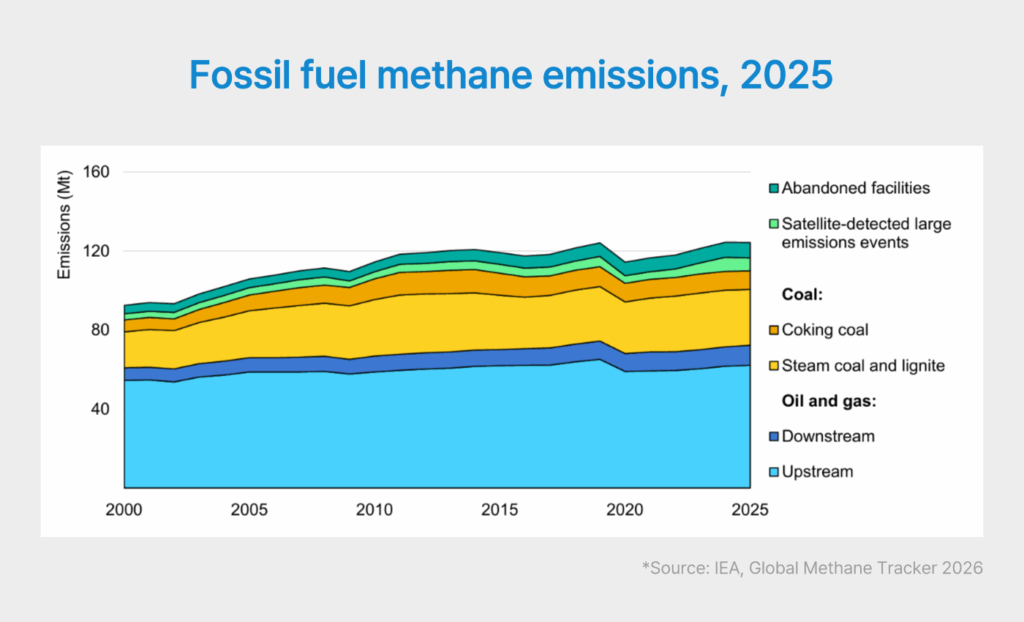
According to the IEA’s Global Methane Tracker 2026, energy-sector methane emissions reached approximately 150 million tonnes in 2025. Within fossil fuels alone, oil accounted for 45 million tonnes, coal for 43 million tonnes, and natural gas for 36 million tonnes. The IEA calculates that capturing the methane currently leaking from fossil fuel production sites would yield the equivalent of roughly 147 million tonnes of additional LNG supply.
Industry is responding on two parallel tracks: scaling up methane reduction technologies — including methane slip mitigation — while building the regulatory compliance infrastructure needed to meet global supply chain requirements.
Why Methane Management Matters Now
Natural gas is primarily composed of methane. Compared to coal or heavy fuel oil, it produces less CO₂ and generates lower levels of sulfur oxides (SOx) and particulate matter — which is why it plays a central role in the energy transition. The challenge lies in what escapes along the way.
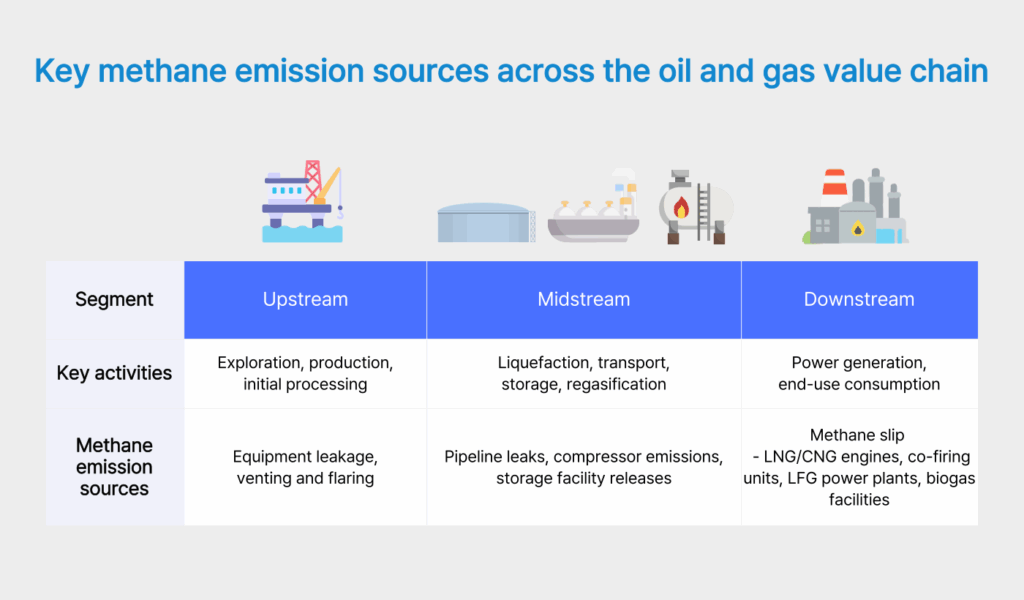
Across the oil and gas value chain, methane enters the atmosphere through three main pathways: leakage (unintended seepage from pipes, valves, and compressors), venting (deliberate release of surplus gas without combustion), and flaring (burning of surplus gas, which converts methane to CO₂ when complete but releases it unburned when combustion is incomplete).
*Leakage: Unintended release of gas through gaps in pipelines, valves, or compression equipment
*Venting: Deliberate discharge of surplus gas directly to the atmosphere without combustion — methane is released as-is, with full warming impact
*Flaring: Combustion of surplus gas; complete combustion converts methane to CO₂, but incomplete combustion allows raw methane to escape
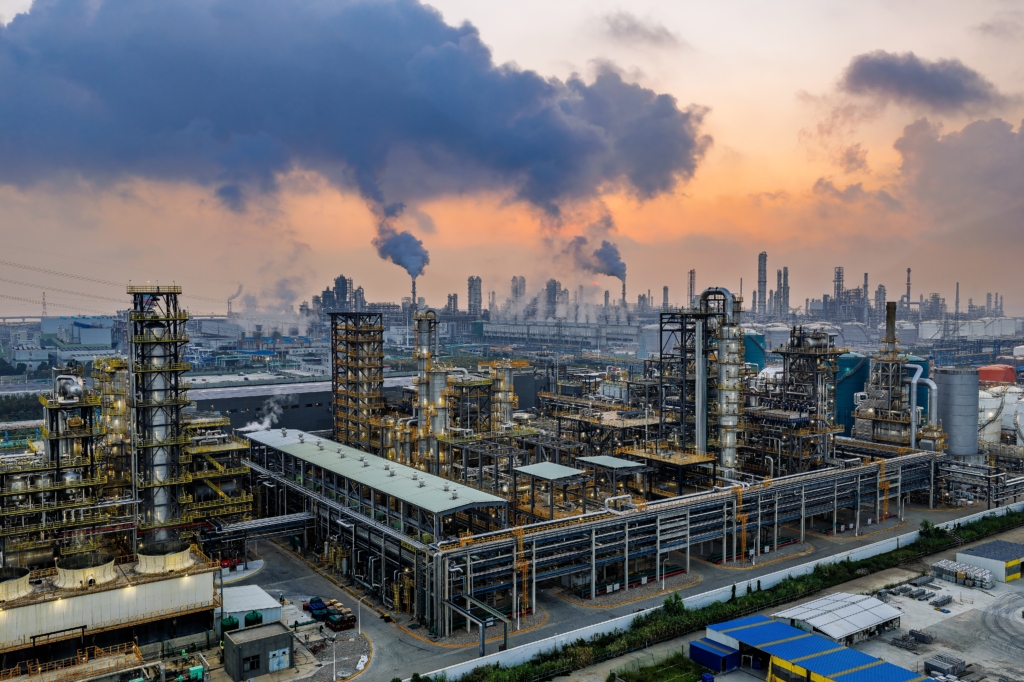
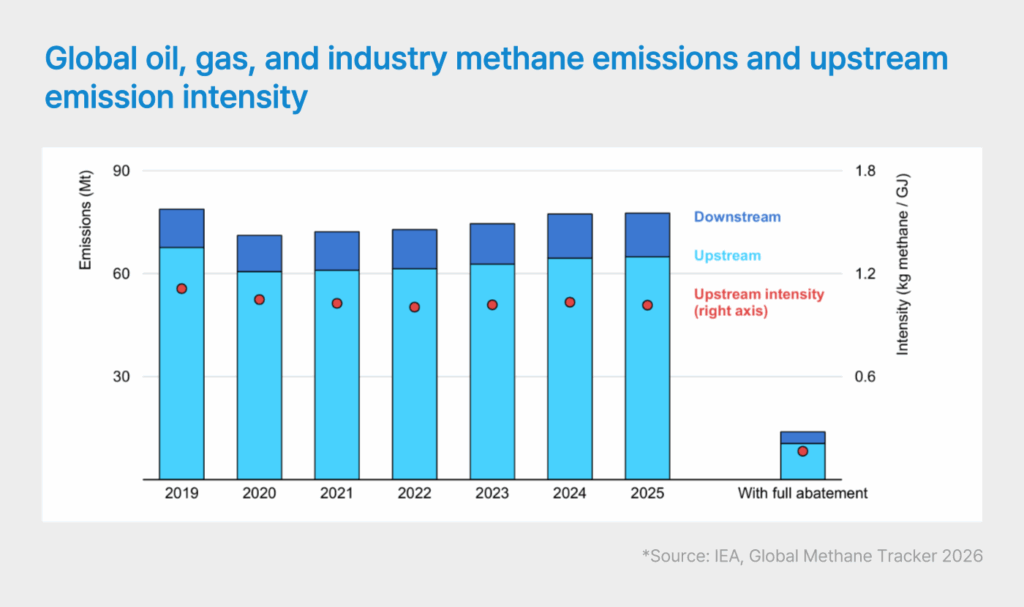
In the oil and gas sector, roughly 80% of emissions originate in the upstream segment — exploration, production, and initial processing. Operational interventions such as leak detection and repair (LDAR), flaring reduction programs, and equipment upgrades address emissions at this stage directly.
As LNG-based power generation and biogas utilization expand, a distinct emissions challenge has emerged further downstream. In LNG and CNG engines, methane co-firing power units, landfill gas (LFG) power plants, and biogas facilities, methane that fails to combust fully exits as exhaust — a phenomenon known as methane slip. Left unmanaged, methane slip undermines combustion efficiency and adds to greenhouse gas loads.
Tightening Global Regulations and Supply Chain Implications
As the stakes around methane management rise, so does the pace of regulatory development.
The Global Methane Pledge (GMP), launched at COP26 in 2021 under U.S. and EU leadership, commits participating countries to cutting global methane emissions by at least 30% from 2020 levels by 2030.
In 2024, the EU introduced its Methane Regulation for the energy sector, tightening measurement, reporting, and verification (MRV) obligations and effectively banning routine venting and flaring. Critically, the regulation extends the same standards to fossil fuels imported into the EU — pushing compliance requirements upstream into global supply chains.
Satellite-based monitoring is accelerating enforcement. Platforms such as MethaneSAT and GHGSat now track large-scale methane releases on a continuous basis, making it possible to verify national and corporate performance against objective data rather than self-reported figures.
How Industry Addresses Methane Emissions
The IEA frames methane reduction as an area where the technology already exists — and where a significant portion of achievable reductions also make economic sense.
1) LDAR(Leak Detection and Repair)
Identifying and repairing methane leaks across pipelines, valves, and process equipment. Increasingly, infrared cameras and continuous sensor networks allow facilities to detect and address leaks in real time rather than on scheduled inspection cycles.
2) VRU(Vapor Recovery Units)
Systems that capture vapors evaporating from storage tanks or process units and return them for reuse. VRUs reduce methane emissions while recovering material value — a case where environmental performance and economics align.
3) Flaring Reduction
Improving combustion efficiency in flaring operations to minimize the unburned methane that escapes during incomplete combustion.
4) Methane Recovery and Utilization
Redirecting captured methane as fuel or for power generation. Expanding biogas and landfill gas utilization falls under the same principle.
5) Oxidation-Based Technologies
Converting methane directly into carbon dioxide and water through catalytic oxidation — substances with significantly lower warming impact than methane itself. As LNG/CNG engines and methane co-firing systems proliferate, the importance of managing methane slip at the exhaust stage has grown sharply. Methane oxidation catalysts are the core technology for this application.
Methane Oxidation Catalysts
Among available methane reduction technologies, methane oxidation catalysts (MOC) are drawing increasing attention from industry. These catalysts address methane slip at the source — treating exhaust from LNG/CNG engines, methane co-firing units, landfill gas power plants, and biogas facilities by oxidizing residual methane in the exhaust stream and converting it to CO₂ and water.
The primary active components in methane oxidation catalysts are platinum group metals (PGMs), particularly palladium (Pd) and platinum (Pt). Palladium shows the highest catalytic activity for methane oxidation and is the most extensively studied material in this field. Oxide supports such as ceria (CeO₂) store and supply oxygen during the reaction, improving both catalytic activity and long-term stability.
Because exhaust composition, operating temperatures, and sulfur concentrations vary considerably across different facilities, catalyst design must be tailored to the specific process conditions of each application. Three performance requirements stand out:
- Low-temperature activity: The catalyst must achieve adequate methane oxidation performance during cold starts or low-load operation, when exhaust temperatures are insufficient to sustain combustion-driven conversion.
- Sulfur tolerance: Sulfur compounds in fuel and exhaust gases inhibit surface reactions. Maintaining performance in the presence of sulfur requires catalysts specifically engineered for durability in sulfur-containing environments.
- Thermal durability: Engines and power generation systems expose catalysts to high operating temperatures and repeated thermal cycling. Long-term stability under these conditions is essential for sustained performance.

Photo1. Heesung Catalysts’ oxidation catalyst
Industry is moving beyond carbon accounting alone. Methane, nitrous oxide (N₂O), perfluorinated compounds (PFCs), and other high-GWP greenhouse gases carry warming impacts far exceeding CO₂ on a per-molecule basis — and managing them is becoming as strategically important as managing CO₂ itself.
In a carbon-neutral economy, competitive positioning will increasingly depend on how precisely a company manages its full greenhouse gas footprint, not just its CO₂ emissions. Methane management technology sits at the center of that shift.
Heesung Catalysts is committed to advancing methane oxidation catalyst technology — and the broader portfolio of environmental catalysts — to support sustainable industry and a cleaner energy future.

FAQ
Q1. What is methane slip?
Methane slip refers to methane that exits a combustion system unburned, escaping with the exhaust rather than being fully oxidized. It occurs in LNG/CNG engines, gas-fired power generation equipment, landfill gas (LFG) power plants, and biogas facilities. As LNG and gas-based infrastructure expands, methane slip is receiving growing scrutiny as a significant and addressable emission source.
Q2. What does tightening global methane regulation mean for industry?
The EU Methane Regulation strengthens MRV obligations for oil, gas, and coal operations and applies the same standards to fossil fuels entering the EU from abroad. Any company participating in supply chains connected to European markets will need robust systems for accurately measuring and reporting methane emissions. With satellite-based monitoring now providing objective verification of actual emissions, the combination of LDAR and MOC technology represents the most effective path to demonstrable compliance.
Q3. What does a methane oxidation catalyst do?
A methane oxidation catalyst converts methane (CH₄) in exhaust gas into carbon dioxide (CO₂) and water (H₂O) through a catalytic oxidation reaction. Because methane’s warming impact per unit is substantially higher than CO₂’s, this conversion — while it does produce CO₂ — significantly reduces the overall climate impact of the exhaust stream.
Q4. What equipment can methane oxidation catalysts be installed on?
MOCs can be applied to any combustion-based system where methane slip occurs: LNG/CNG engines, methane co-firing power units, landfill gas (LFG) power plants, and biogas facilities. Because exhaust composition, operating temperature, and sulfur content differ significantly across applications, proper catalyst selection and system design are essential to achieving real-world emission reductions. Catalysts must deliver low-temperature activity, sulfur tolerance, and thermal durability to perform reliably under actual operating conditions.
