


Why Solving Factory Odor Starts with the Emission Source
2026.07.28
Key Takeaways
- Reducing factory odor and VOCs starts with analyzing the emission source process and the emission characteristics.
- Abatement systems and reduction technologies are selected process by process, based on the emission characteristics of each: coating and drying, coating/adhesives/printing, food processing, and feed manufacturing.
- How VOC oxidation catalysts work, and why gas composition, operating conditions, and equipment design are what determine catalyst performance.
Factory odor is one of the most immediate environmental problems local residents experience firsthand. Even at low concentrations, it can affect daily life, and when it recurs, it turns into a source of complaints and operational risk for the facility.
Korea’s Malodor Prevention Act was enacted to manage odor so that people can live in a healthy, comfortable environment. Under this law, the government designates areas where odor complaints persist, or are likely to arise, as odor management zones. As of January 2026, there are 59 such zones across 13 metropolitan cities and provinces nationwide. These zones span industrial complexes, livestock facilities, food processing plants, and more, which shows that odor is not confined to any single industry but is an environmental issue across industrial sites as a whole.
Industries that use organic solvents or involve heat treatment, such as coating, adhesives, printing, food processing, rendering, and feed manufacturing, release volatile organic compounds (VOCs) and odor at the same time. So the first step in reducing industrial emissions effectively is not masking the smell, but identifying where the emissions come from and what they contain. Once we understand the emission characteristics, we can select the right reduction technology and catalyst.
What Causes Factory Odor
Factory odors may all seem alike, but their actual sources differ from one process to the next. In coating and drying, VOCs from paints and organic solvents are the main culprit, while in food processing and rendering, the organic smells come from cooking, smoking, heating, and frying. In feed manufacturing, the raw materials and the drying and heating conditions combine to produce complex odors.
Even within the same industry, emission characteristics can vary by product, so the cause of the emissions has to be identified before selecting odor reduction equipment. Gas temperature and flow rate, VOC concentration, and just as importantly moisture, dust, oil mist, operating hours, and the operating conditions of any existing abatement system all need to be analyzed before the right treatment method can be designed.
Coating and Drying
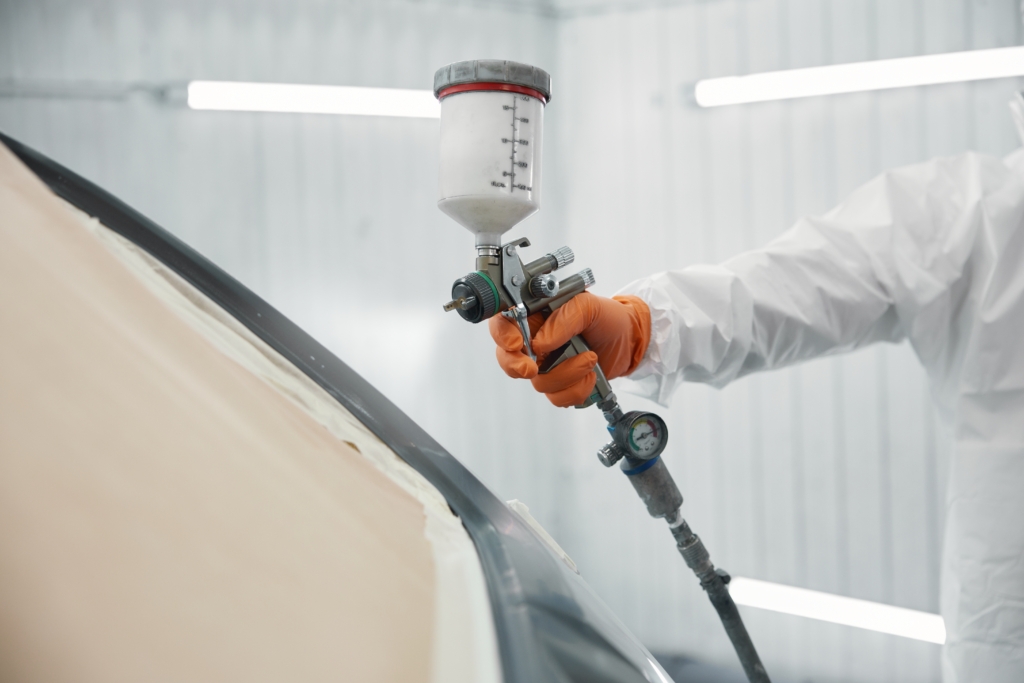
In coating and drying, the organic solvents in paints, thinners, and cleaning agents evaporate during application and drying, releasing VOCs, which makes VOC control more critical here than anywhere else on the industrial floor. Depending on the emission characteristics, reduction technologies such as adsorption, thermal oxidation, and regenerative catalytic oxidation (RCO) can be applied.
In paint booths and drying ovens, gas concentration, flow rate, and temperature fluctuate noticeably. Because these swings directly affect how well the VOC abatement system performs, the treatment technology has to be tuned to match them.
Coating, Adhesives, and Printing
In coating, adhesive, and printing processes, the solvents in coating fluids, adhesives, and inks evaporate during drying and give off VOCs. Even on the same production line, solvent composition and emission concentration shift with the raw materials and products used, so the specifics of each process have to be examined closely.
Moisture, dust, and tacky substances can also enter the stream together and degrade abatement performance. When designing VOC reduction equipment, then, it’s important to consider not only the gas composition but also the pretreatment requirements and how the new system will tie into existing equipment.

Food Processing and Rendering
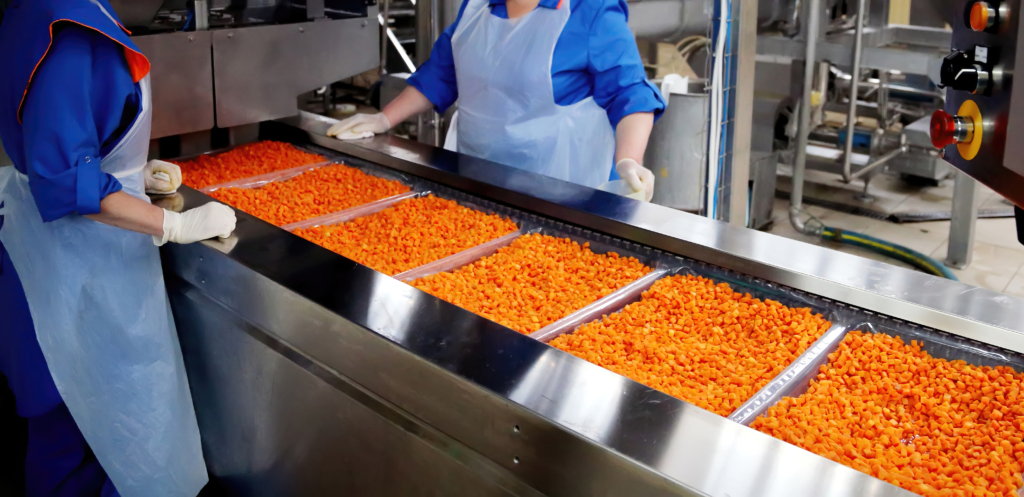
In food processing and rendering, cooking, smoking, frying, drying, and fat production give off a range of organic odors (moisture, oil mist, fatty acids, and more), depending on the raw materials and heat treatment involved. Since these can compromise abatement performance, thorough pretreatment is essential, after which catalyst-based reduction or other treatment technologies can be applied to match the emission characteristics.
Feed Manufacturing
Feed manufacturing draws on a wide range of raw materials and runs through many production stages, making it a prime example of an industry that generates complex odors. Odor arises at different points across the line, from raw material storage through grinding, mixing, drying, and cooling, so the first priority is pinpointing where emission sources concentrate.
The emissions often carry moisture, dust, and organic odor components together, which makes pretreatment the deciding factor in abatement performance. Matching the approach to site conditions (scrubbing, adsorption, thermal oxidation, catalytic oxidation) is what delivers stable, reliable odor reduction.

Design Conditions for Factory Odor and VOC Abatement Systems
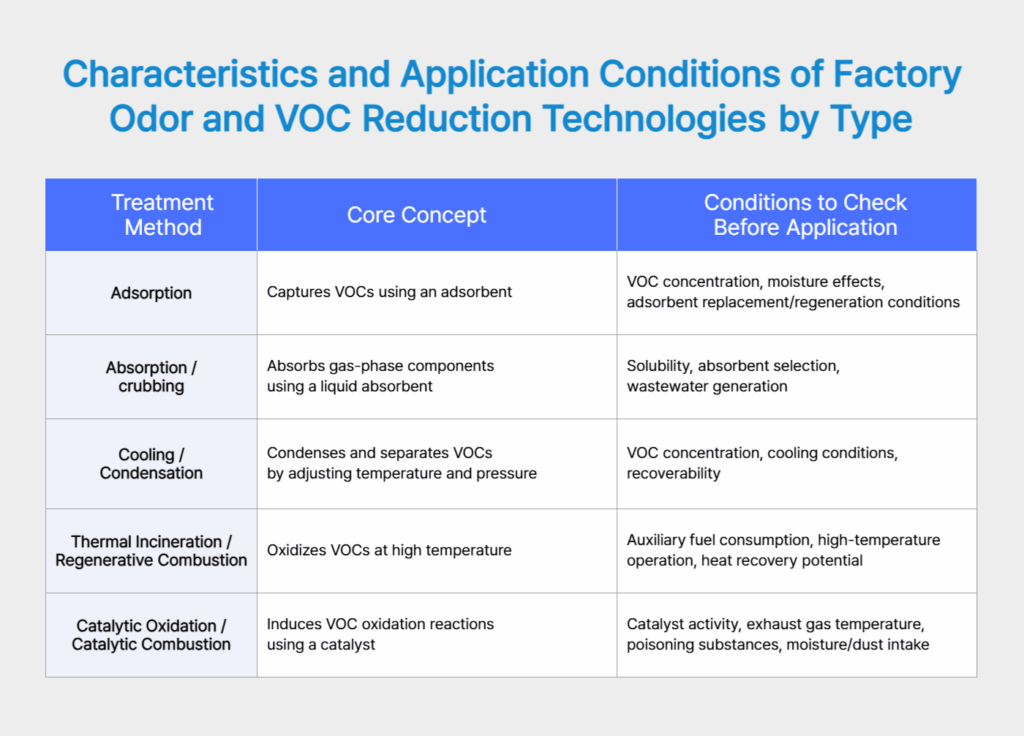
Factory odor and VOC abatement systems are designed around the characteristics of the emissions. VOC concentration, flow rate, temperature, moisture, dust, treatment targets, operating hours, and maintenance requirements all factor into evaluating technologies such as adsorption, absorption and scrubbing, thermal incineration, catalytic oxidation, and RCO.
How Do VOC Oxidation Catalysts Work?
Catalytic oxidation passes the emissions through a catalyst bed, converting organic compounds into carbon dioxide and water. The key to it is activation energy. Oxidizing organic compounds normally takes high temperatures, but at the catalyst surface the reaction pathway changes and the activation energy drops. Where direct combustion requires 700–800°C, catalytic oxidation proceeds at 250–400°C, lowering the operating temperature and cutting both auxiliary fuel use and operating burden.
Industrial VOC oxidation catalysts rely mainly on precious-metal active materials such as platinum (Pt) and palladium (Pd). Precious metals show high oxidation activity even at low temperatures, and we tailor the mix of active materials and the loading method to the target VOC components. Add to that a coating technology that distributes the active material evenly across a ceramic or metal substrate, and the real-world performance is set.
That said, catalyst performance depends heavily on gas composition and operating conditions. Components such as sulfur (S), chlorine (Cl), phosphorus (P), silicon (Si), and heavy metals can block the catalyst’s active sites or trigger chemical changes that lower its activity. Oil mist and dust can physically coat the surface and obstruct the reaction, while a sudden temperature spike can cause sintering—the clumping of active-material particles—which shrinks the effective surface area. So applying a catalyst calls for a thorough analysis of gas composition and operating conditions, paired with the selection of a catalyst suited to them.
Equipment Conditions for Getting the Most from a Catalyst
Abatement performance isn’t determined by the catalyst alone. The equipment structure it sits in, the gas temperature and flow rate, pretreatment conditions, dust and moisture control, and operating patterns all shape the actual reduction rate and catalyst lifespan. Even with the same catalyst, once space velocity (SV) exceeds the design value, reaction time falls short; when the inlet temperature stays below the design range, conversion drops. And if pretreatment fails to filter out mist and dust, the catalyst needs replacing sooner than expected.
Catalyst specifications and equipment configuration, then, have to be designed together. When the catalyst specialist and the system integrator share these conditions from the earliest stage, they can pin down exactly how to apply the catalyst and optimize the equipment.
Reducing factory odor and VOCs begins with a clear understanding of the source process and the emission conditions. Building on our catalyst technology for industrial emission reduction, Heesung Catalysts continues to expand the possibilities for applying VOC and odor removal catalysts.

FAQ
Q1. When a factory odor complaint comes in, what should we check first?
Before choosing an abatement system, identify the emission source process and the characteristics of the emissions. Odors may all smell alike, but each has a different cause and a different composition. Analyzing gas temperature and flow rate, VOC concentration, moisture, dust, oil mist, operating hours, and the operating conditions of any existing abatement system is what lets you design a treatment method suited to the process.
Q2. Which processes typically generate VOCs and odor?
VOCs and odor can arise across any industry that uses organic solvents or involves heat treatment. In coating and drying, VOCs from paints and organic solvents are the main emissions; in food processing and rendering, organic odors come from cooking, smoking, and heating. Feed manufacturing is a prime example of complex odors, arising from the raw materials and drying conditions involved.
Q3. How do VOC oxidation catalysts remove VOCs?
They pass the emissions through a catalyst bed, converting organic compounds into carbon dioxide and water. Oxidation normally takes high temperatures, but at the catalyst surface the reaction pathway changes and the activation energy drops. Unlike direct combustion, which requires 700–800°C, catalytic oxidation proceeds at 250–400°C, lowering the operating temperature and helping cut auxiliary fuel use and operating burden.
Q4. What should we consider when applying a VOC oxidation catalyst?
Consider not just the catalyst but the emissions and equipment specifications alongside it. Gas composition, temperature, flow rate, moisture, dust, and operating conditions all directly affect the catalyst’s performance and lifespan. Designing the catalyst and equipment together, process by process, is what delivers stable, reliable VOC reduction.
