

The Race for Power Behind Always-On AI Data Centers: Where Do Catalysts Fit In?
2026.07.20
Training and running artificial intelligence models happens largely in AI data centers. As high-performance AI services such as generative AI, agentic AI, and video generation models spread rapidly, data center electricity demand has surged alongside them. Competitiveness in the AI industry now depends not only on semiconductor performance, but on how quickly and reliably companies can secure the enormous amounts of power these facilities require.
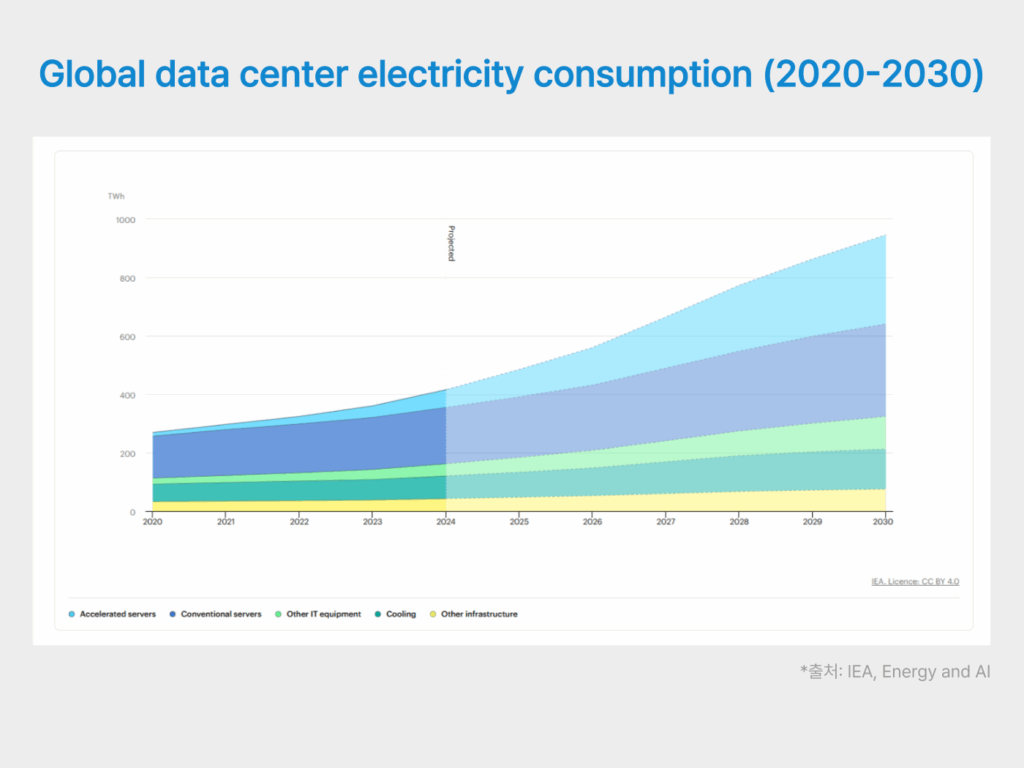
In its report on AI and energy, the International Energy Agency (IEA) projects that global data center electricity consumption will roughly double from 415 TWh in 2024 to 945 TWh in 2030. AI-dedicated data centers show higher power density and greater load volatility than conventional facilities, accelerating change across the entire energy infrastructure, from power grids and generation assets to energy storage systems (ESS) and distributed power sources.
This shift also intersects with catalyst technology. While catalysts are not used inside data centers themselves, they play a broad role in the power generation equipment and fuel cell-based distributed power systems that supply them.
Why Do AI Data Centers Need New Ways to Source Power?
AI data centers consume far more electricity than conventional ones. The main driver is AI-optimized servers: massive fleets of high-performance GPUs and servers running AI training and inference workloads, pushing power consumption steadily upward.
The IEA notes that the power density of AI servers is rising fast. By 2027, a single server rack in a high-performance AI data center is expected to consume as much electricity as up to 65 households. In other words, AI data centers are not just getting bigger; the power each server demands is also climbing rapidly.
The challenge is that power infrastructure struggles to keep pace with the AI industry’s growth. Building power plants, expanding transmission networks, and connecting to the grid all take considerable time, while investment in AI data centers is expanding much faster. As a result, data center operators are looking beyond the existing grid, siting facilities near power plants and exploring options such as on-site generation, distributed power, and energy storage.
How Do AI Data Centers Secure Power?
For AI data centers, reliable power supply is paramount. Because any interruption directly affects service operations, operators need not only a stable primary supply but backup power as well.
1. Siting data centers near power plants
A growing number of data centers are being built close to power plants or large-scale power supply infrastructure. Locating near generation assets reduces the burden on transmission networks and helps secure stable power. It can also cut the time and cost of grid connection, making siting strategies that consider generation infrastructure and data center location together increasingly important.
2. On-site generation
Another approach is producing electricity directly at or near the data center site using LNG gas turbines or gas engines. Because it can deliver power relatively quickly even when grid connection is delayed, on-site generation is seen as a practical alternative.
The IEA projects that by 2030, roughly 15–27 GW of on-site natural gas generation capacity will supply data centers in the United States alone. This signals a shift in how data centers source power, moving from grid-centric supply toward a wider mix of distributed sources.
3. Fuel cell-based distributed power
Fuel cells are also gaining attention as a new power source for data centers. Generating electricity from hydrogen or fuel gas, they can serve a range of roles including primary, backup, and emergency power. Their modular design makes them well suited to scaling capacity in stages as power demand grows.
4. Energy storage and next-generation power sources
Power demand at AI data centers can swing sharply, so technologies that manage these fluctuations are equally important. ESS can strengthen power stability at facilities with highly variable loads. The IEA expects around 20–25 GW of battery storage to be installed at data centers worldwide by 2030. For the longer term, next-generation carbon-free sources such as small modular reactors (SMRs) are also under discussion.
What Catalyst Technologies Does This New Power System Require?
Catalysts are not applied within data centers directly, but they play an essential role in the power generation equipment and fuel cell systems that keep them running. As LNG gas turbines, gas engines, and fuel cell-based distributed power expand, catalyst technologies that reduce emissions and improve electrochemical efficiency are becoming increasingly important.
SCR catalysts for NOx reduction
LNG gas turbines and gas engines are among the most common power supply options for on-site generation and distributed power at AI data centers.
LNG produces fewer emissions than coal, but combustion can still generate nitrogen oxides (NOx). Because NOx contributes to air pollution and fine dust formation, generation equipment requires exhaust aftertreatment technology to reduce it. The most widely used solution is the SCR (Selective Catalytic Reduction) catalyst.
Also known as a DeNOx catalyst, the SCR catalyst uses ammonia-based reducing agents to convert nitrogen oxides into nitrogen and water. It is widely applied across power generation, industrial facilities, marine vessels, and other exhaust treatment applications.
As AI data centers drive greater adoption of LNG-based generation, NOx reduction and environmental compliance are becoming as critical as generation efficiency. In this respect, SCR catalysts are a core technology underpinning the power infrastructure of AI data centers.
Hybrid catalysts for controlling ammonia slip
The SCR process uses ammonia-based reducing agents to cut NOx. Some of that ammonia can pass through unreacted and be released, a phenomenon known as ammonia slip. Because it can cause secondary pollution and odor and affect downstream equipment, managing residual ammonia is an important part of operating generation facilities.
Hybrid catalysts selectively oxidize the ammonia remaining after the SCR process, improving the environmental performance of the exhaust stream. In short, where SCR reduces nitrogen oxides, the Hybrid catalyst is an aftertreatment technology that manages residual ammonia downstream of SCR.
By applying SCR and Hybrid catalysts together, LNG gas turbines and gas engines can control both NOx and residual ammonia, completing the exhaust aftertreatment system.
Electrocatalysts that boost fuel cell performance
Fuel cells generate electricity through the electrochemical reaction of hydrogen and oxygen. With no combustion involved, they are regarded as a highly efficient form of distributed power, and data centers are evaluating them for primary, backup, and emergency power applications.
Polymer electrolyte membrane fuel cells (PEMFCs) offer fast response and modular configuration, making them well suited to distributed and backup power, while solid oxide fuel cells (SOFCs) show strong potential for primary power thanks to their high generation efficiency. The key component determining PEMFC performance is the electrocatalyst, which accelerates the hydrogen oxidation and oxygen reduction reactions inside the fuel cell to improve power generation efficiency.
Electrocatalyst performance affects not only a fuel cell’s output and efficiency but also its durability and economics. As fuel cells take on a larger role in distributed and emergency power for AI data centers, demand for high-performance electrocatalysts is expected to grow with them.
Catalyst Technology for Reliable Power Infrastructure in the AI Era
Keeping power-hungry AI data centers running reliably calls for a new kind of power system. As grids, on-site generation, fuel cells, and energy storage become increasingly interconnected, catalyst technology is establishing itself as a foundational technology for improving both generation efficiency and environmental performance.
Drawing on catalyst expertise accumulated across a wide range of power generation and fuel cell applications, Heesung Catalysts improves energy efficiency and environmental performance, supporting the transition to sustainable power systems.

FAQ
Q1. Why do AI data centers need on-site generation?
AI data centers run high-performance servers and GPUs at massive scale, making reliable power supply essential. Because expanding transmission networks and securing grid connections takes time, on-site generation, which produces electricity at or near the data center site, has emerged as a practical alternative. LNG gas turbines, gas engines, and fuel cells are among the leading options used together for distributed and on-site power at data centers.
Q2. Why do LNG gas turbines need SCR catalysts?
LNG gas turbines deliver stable power, but combustion can generate nitrogen oxides (NOx). SCR catalysts reduce emissions by converting NOx into nitrogen and water using ammonia-based reducing agents. For equipment that runs long hours, such as on-site generation for data centers, SCR catalysts play an important role in meeting environmental regulations and maintaining stable operation.
Q3. How is ammonia slip managed in SCR applications?
The SCR process uses ammonia-based reducing agents to reduce NOx. Ammonia that passes through unreacted can be released as emissions, known as ammonia slip. Hybrid catalysts, installed downstream of the SCR, selectively oxidize this slip to reduce residual ammonia and improve the environmental performance of the exhaust stream. This allows operators to manage both NOx reduction and overall exhaust quality.
Q4. Why are fuel cells attracting attention as a power source for AI data centers?
Fuel cells are highly efficient distributed power sources that generate electricity from hydrogen or fuel gas. Their modular construction allows capacity to scale flexibly with growing power demand, and they are being evaluated for primary, backup, and emergency power. PEMFCs in particular show strong potential in data center power systems that demand fast response, and electrocatalyst performance has a significant impact on fuel cell output, efficiency, and durability.
Q5. What should be considered when applying SCR catalysts to data center generation equipment?
Applying SCR catalysts to on-site generation for data centers requires a comprehensive review of operating conditions. The type and specifications of the catalyst can vary depending on exhaust gas temperature and flow rate, NOx concentration, operating hours, load fluctuations, and ammonia slip management requirements.
That is why early-stage collaboration among power equipment manufacturers, EPC contractors, environmental equipment suppliers, and catalyst specialists matters. Heesung Catalysts develops SCR catalysts for NOx reduction in power generation as well as Hybrid catalysts for managing ammonia slip downstream of SCR, and we draw on our experience developing and mass-producing a wide range of industrial catalysts to propose catalyst solutions suited to each facility’s operating conditions.
