

Why SCR Catalysts Are Important for Power Plant NOx Removal
2026.03.04
Nitrogen oxides (NOx) emitted from power plants are among the most representative air pollutants generated during fuel combustion. Because NOx contributes to the formation of particulate matter and ozone and can negatively affect human health, it must be managed in accordance with legal standards.
In the past, the main objective was simply to comply with emission concentration limits. Today, however, the regulatory framework has evolved to include annual emission caps and integrated environmental permit conditions. As a result, NOx control has become a critical management factor that affects not only regulatory compliance but also the stable operation of power plants.
Regulatory Framework for NOx Emissions in Power Plants
NOx management in power plants is governed simultaneously by several regulatory systems.
1. Clean Air Conservation Act
Under the Clean Air Conservation Act, power plants must comply with permitted emission concentration limits. Emission concentrations are continuously monitored and transmitted through stack monitoring systems, and exceeding the limit may result in administrative penalties or surcharges.
2. Special Act on the Improvement of Air Quality in Air Control Zones
Under the Special Act on the Improvement of Air Quality in Air Control Zones, facilities located in designated air control zones are subject to annual total emission caps for NOx. Even if concentration limits are met, an increase in plant operation rates may lead to higher annual emissions and a risk of exceeding the allocated cap.
3. Act on the Integrated Control of Pollutant-Discharging Facilities
Power plants above a certain size are subject to integrated environmental permits under the Act on the Integrated Control of Pollutant-Discharging Facilities. For facilities subject to this permit, the operating conditions may require pollution control equipment to be managed at the level of *Best Available Techniques (BAT). In such cases, stable operation of NOx treatment systems is directly linked to maintaining the permit.
Because power plants must simultaneously consider concentration limits, total emission caps, and permit conditions, long-term operational stability requires a more precise management system rather than simply meeting a single regulatory threshold.
*Best Available Techniques (BAT): Technologies and operational management practices that minimize pollutant emissions while maintaining strong economic feasibility in industrial environments.
NOx Control Technologies: SNCR and SCR
Two primary technologies are used in power plants to reduce NOx emissions: Selective Non-Catalytic Reduction (SNCR) and Selective Catalytic Reduction (SCR). Both methods reduce NOx into nitrogen (N₂) and water (H₂O) using ammonia (NH₃) or urea, but they differ in reaction conditions and operational approaches.
1. SNCR(Selective Non-Catalytic Reduction)
SNCR induces the reduction reaction by injecting a reducing agent directly into a high-temperature zone of approximately 850–1,100°C without using a catalyst. The system configuration is relatively simple and initial investment costs are lower. However, because the effective reaction temperature window is narrow, treatment efficiency can vary depending on operating conditions.
2. SCR(Selective Catalytic Reduction)
SCR uses a catalyst to enable the reduction reaction at relatively lower temperatures. As the exhaust gas passes through the catalyst layer, NOx is converted into nitrogen and water. This process generally maintains more stable removal efficiency even when operating conditions fluctuate. Due to this advantage, SCR typically achieves higher removal efficiency compared with SNCR.
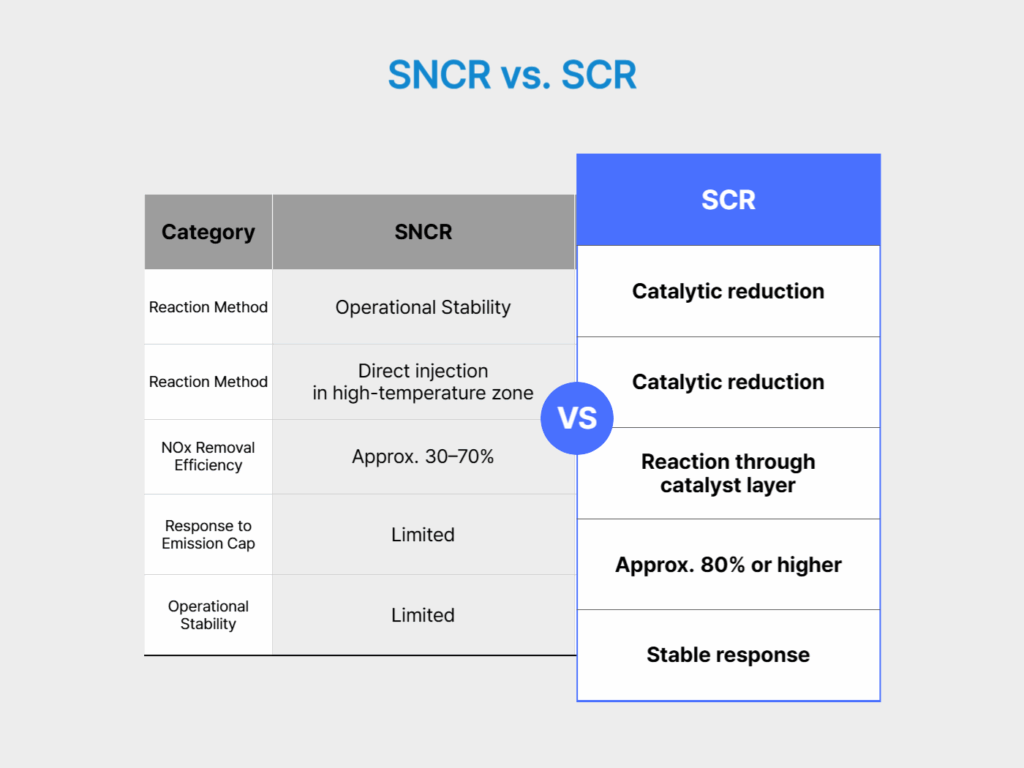
When meeting concentration limits was the primary goal, operating SNCR alone could provide a certain level of compliance. However, as total emission management systems have strengthened, maintaining stable annual emission levels has become more important. As a result, technologies capable of consistently achieving higher removal efficiency—such as SCR—are being adopted more widely. In many cases today, SCR serves as the primary system while SNCR is used as a supplementary method.
Key Inspection Points for SCR Systems in Power Plants
Installing an SCR system does not automatically guarantee consistent performance. The actual NOx removal efficiency can vary depending on factors such as fuel characteristics, exhaust gas composition, operating temperature range, and load fluctuations.
Under total emission management systems, even small variations in removal efficiency can affect annual emission levels. Therefore, maintaining long-term operational stability of the NOx control system is essential.
Situations where SCR catalyst or NOx control system inspection may be required
- Gradual increases in NOx emission concentration
- Increased ammonia injection required to maintain the same NOx removal efficiency
- Unstable fluctuations in ammonia slip levels
- Catalyst operating time approaching its design lifetime
- Increased pressure drop or abnormal differential pressure changes
These changes may sometimes result from temporary operational deviations, but they may also indicate catalyst deactivation, poisoning, or physical damage. If reduced removal efficiency continues, it may lead to exceeding emission caps, higher emission charges, or violations of permit conditions. Therefore, when early warning signs appear, proactively diagnosing catalyst conditions and reviewing replacement or reinforcement options is recommended.
Catalyst Solutions for Power Plant SCR Systems
In an environment of increasingly stringent NOx regulations, the key factor is not simply whether a control system is installed, but whether treatment performance can be maintained stably over the long term under actual operating conditions.
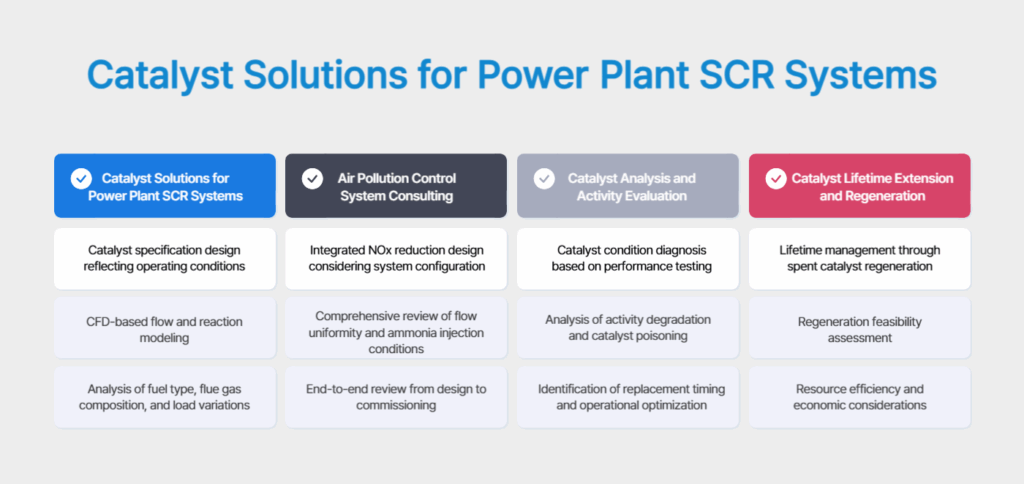
To address this, Heesung Catalysts provides technical support that covers catalyst specification review and lifecycle management based on the operating conditions of each power plant.
1. Customized Catalyst Design
Heesung Catalysts analyzes operating conditions using CFD-based flow and reaction modeling to determine catalyst specifications optimized for the actual plant environment. Because each power plant differs in fuel characteristics, exhaust gas composition, operating temperature ranges, and load fluctuation patterns, the design process reflects real operating conditions rather than relying solely on standard specifications.
2. Air Pollution Control System Consulting
Stable NOx removal depends not only on catalyst performance but also on system structure, flow uniformity, and ammonia injection conditions. Heesung Catalysts reviews the entire process—from design and supply to commissioning—while evaluating operating conditions across the system to support stable long-term NOx control.
3. Catalyst Analysis and Activity Evaluation
During long-term operation, SCR catalysts may experience deactivation or poisoning, which directly affects removal efficiency. Heesung Catalysts analyzes catalyst conditions through performance testing and recycling evaluation, helping determine optimal replacement timing and operational improvement strategies.
4. Catalyst Lifetime Extension and Regeneration
From a long-term operational perspective, Heesung Catalysts works with customers to reduce system burden and optimize lifecycle costs. Although catalysts eventually require replacement, not all used catalysts must be discarded immediately. In many cases, regeneration and performance recovery are possible. Through spent catalyst collection, performance analysis, and regeneration processes, Heesung Catalysts proposes management solutions that balance resource efficiency and economic feasibility.
If a review of catalyst specifications or lifecycle management is needed under current operating conditions, further evaluation can be conducted by checking the environmental catalyst product information and submitting an inquiry.
➡️ Related Reads
