

Heesung Catalysts Receives Outstanding Presentation Paper Award for Ammonia-Fueled Ship Emission Control Research
2026.04.25
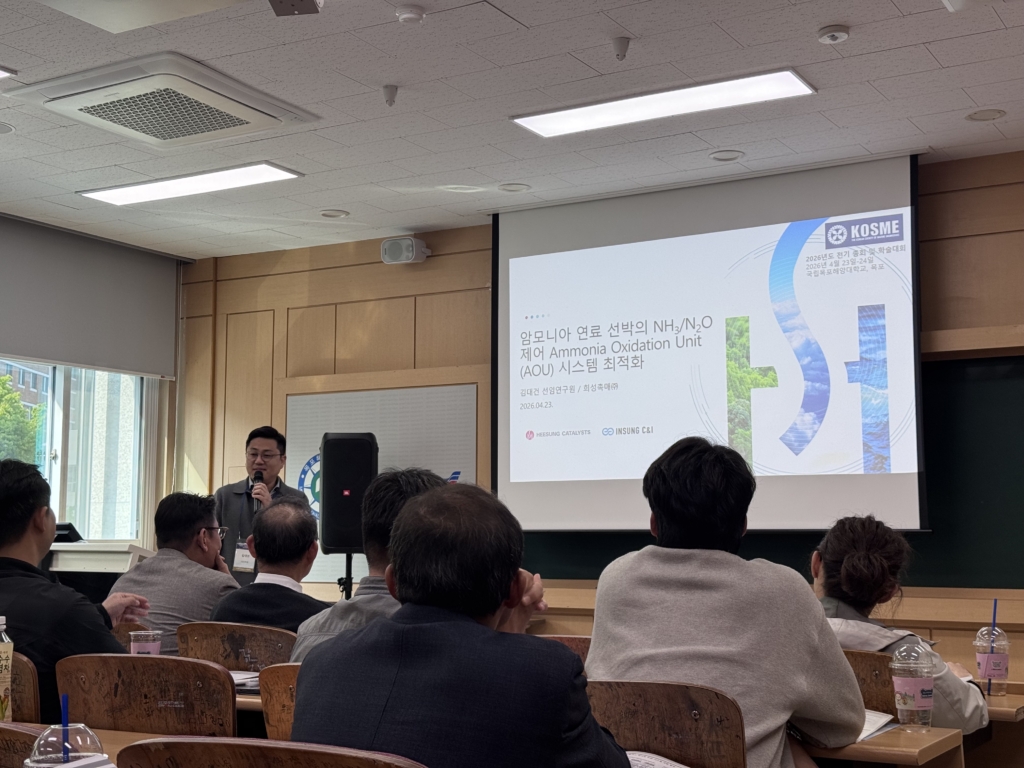
Senior Researcher Dr. Daegun Kim of Heesung Catalysts received the Outstanding Presentation Paper Award at the Korean Society of Marine Engineering (KOSME), held from April 23 to 25, 2026.
At the conference, Dr. Kim presented a paper titled “Optimization of an AOU (Ammonia Oxidation Unit) System for NH₃ and N₂O Control in Ammonia-Fueled Ships.” The presentation focused on catalyst-based aftertreatment system optimization technologies designed to reduce ammonia slip and nitrous oxide (N₂O) emissions that may occur in ammonia-fueled vessels.
The Importance of Emission Control Technologies for Ammonia-Fueled Ships
As the International Maritime Organization (IMO) accelerates decarbonization policies, the adoption of eco-friendly vessels and low-carbon fuels is rapidly expanding. Among them, ammonia-fueled engine technologies are gaining attention as one of the next-generation propulsion solutions for the maritime industry.
However, the use of ammonia fuel can result in ammonia slip and N₂O emissions during combustion and aftertreatment processes. Ammonia requires careful management due to its toxicity, while N₂O is recognized as a greenhouse gas that must be reduced from an environmental perspective. As a result, securing effective aftertreatment technologies has become an important requirement for the commercialization of ammonia-fueled ships.
Optimization of an AOU System for Simultaneous Reduction of Ammonia and N₂O
The presentation introduced optimization technologies for an AOU (Ammonia Oxidation Unit) system designed to simultaneously reduce residual ammonia and nitrous oxide emissions from ammonia-fueled ships.
The AOU system is an aftertreatment solution that uses catalysts to remove residual ammonia from exhaust gases while also reducing N₂O generated during the process. In this study, a high-temperature durable AOC (Ammonia Oxidation Catalyst) was combined with a DeN₂O catalyst capable of operating in medium-temperature ranges, demonstrating the potential to effectively reduce ammonia and N₂O emissions at lower temperatures compared to conventional high-temperature combustion systems.
In particular, the system utilized the exothermic characteristics of the AOC to maintain internal system temperature, enabling stable emission reduction performance even under medium-temperature operating conditions of approximately 300–400°C. The study demonstrated the practical applicability of catalyst-based emission control technologies for ammonia-fueled ships.
Continued Development of Practical Aftertreatment Technologies for Marine Applications
Dr. Kim shared his thoughts on the award, stating, “As interest in eco-friendly marine fuels and emission reduction technologies continues to grow, it is very meaningful to be able to share our research results at the conference and receive positive recognition.”
He added, “It is especially meaningful that we were able to implement a practically applicable system based on catalyst technologies previously developed by Heesung Catalysts. We will continue our efforts to develop aftertreatment and emission reduction technologies applicable to real marine environments and actively introduce Heesung Catalysts’ catalyst technologies to the industry.”
Heesung Catalysts will continue developing catalyst-based emission reduction technologies required for eco-friendly energy transition sectors, including ammonia-fueled ships, while expanding practical solutions applicable to industrial environments.
