

Improving Gas Turbine Power Generation Efficiency and Emissions Management: The Role of Catalysts
2026.09.21
Key Takeaways
- How combined-cycle power generation recovers heat from gas turbine exhaust in an HRSG to produce additional electricity and improve generation efficiency
- Managing CO/HC, NOx, yellow plume, and ammonia slip, which vary with a gas turbine’s operating conditions
- Heesung Catalysts’ integrated emissions reduction solutions—including oxidation catalysts, Smart SCR, Hybrid catalysts, and High-Temperature SCR—tailored to each power facility’s operating characteristics
Electricity demand is surging across industries, driven in part by AI data centers, and this is fueling growing interest in power generation technologies capable of supplying large amounts of electricity reliably. Interest in gas turbines and combined-cycle power generation has grown further with Korea’s first investment project in the United States: the construction of a gas-fired combined-cycle power plant.
Gas turbines deliver high generation efficiency and can adjust output quickly, making them well-suited to changing electricity demand. Combined-cycle power generation takes this a step further by capturing the hot exhaust from a gas turbine and using it to generate additional electricity, producing more power from the same amount of fuel.
This article outlines how gas turbines, heat recovery steam generators (HRSGs), and combined-cycle systems work together, examines the emissions-control challenges that arise under different operating conditions, and introduces the abatement technologies Heesung Catalysts has developed to address them.
How Gas Turbines and Combined-Cycle Power Generation Work
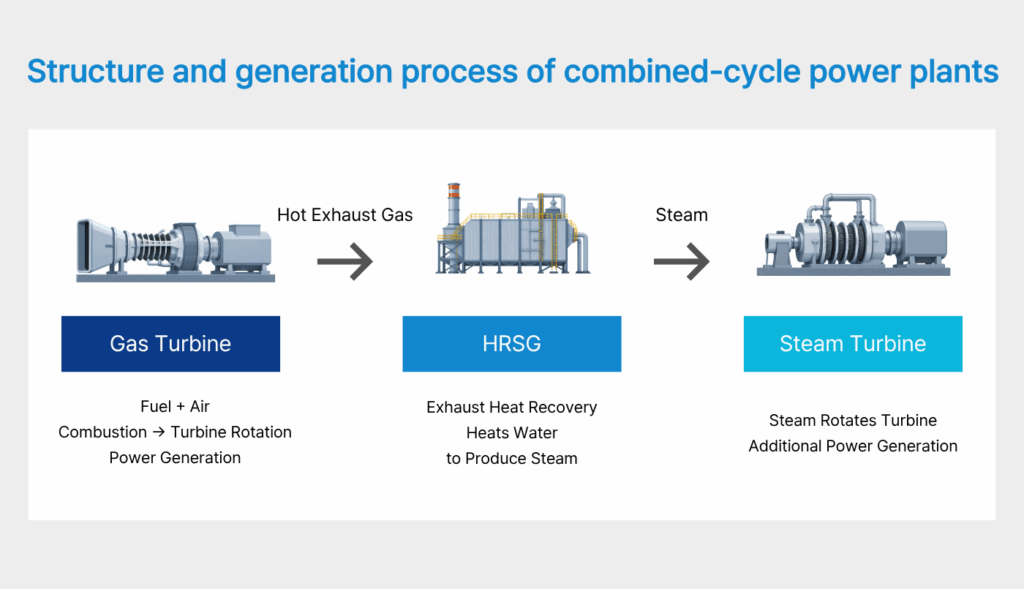
A gas turbine generates electricity by burning compressed air and fuel and using the resulting high-temperature, high-pressure gas to spin a turbine. Gas turbine power generation falls into two categories: simple cycle and combined cycle.
| Category | Simple Cycle | Combined Cycle |
|---|---|---|
| Core equipment | Gas turbine | Gas turbine + HRSG + steam turbine |
| Exhaust gas use | Released | Heat recovered in HRSG |
| Generation method | Gas turbine only | Gas turbine + steam turbine |
| Generation efficiency | Relatively lower | Relatively higher |
| Advantage | Simple design, fast startup | High generation efficiency |
A simple-cycle system releases the gas turbine’s exhaust without recovering it. Because the design is relatively straightforward and starts up quickly, it can adjust output rapidly to match shifts in electricity demand.
A combined-cycle system recovers the gas turbine’s hot exhaust in an HRSG, which converts it into steam that drives a steam turbine. This approach, known as combined-cycle gas turbine (CCGT) generation, runs the gas turbine and steam turbine together: the gas turbine generates power first, and the remaining exhaust heat is put to use in additional power generation, giving combined cycle a higher generation efficiency than simple cycle.
Why Gas Turbine Emissions Require Careful Management
Gas turbines produce a range of emissions, including NOx, during combustion, so managing them reliably matters. As environmental regulations on power generation equipment tighten, technologies that help operators meet emissions standards are becoming increasingly important.
The U.S. Environmental Protection Agency (EPA) manages emissions from gas turbines and other stationary combustion sources through its New Source Performance Standards (NSPS) program. Within this framework, 40 CFR Part 60 Subpart KKKKa, amended in January 2026, sets detailed emissions requirements for new and reconstructed or modified gas turbines that meet certain criteria. For large, high-utilization new natural gas turbines in particular, a combination of combustion controls and selective catalytic reduction (SCR) has been designated as the Best System of Emission Reduction (BSER), with a NOx emissions limit of around 5 ppm at loads above 70%.
That said, not every gas turbine is held to the same standard. Requirements vary depending on equipment size, utilization rate, fuel type, and operating environment, and operators must also confirm applicable state and local air quality permitting requirements.
How HRSGs Relate to Emissions Aftertreatment Systems
Because gas turbines generate electricity by burning fuel, their operation produces a variety of emissions. Combustion generates nitrogen oxides (NOx), along with carbon monoxide (CO) and hydrocarbons (HC), and where selective catalytic reduction (SCR) is used, unreacted ammonia passing downstream — known as ammonia slip — also needs to be managed.
Emissions characteristics shift across a gas turbine’s operating phases: startup, load changes, and steady-state operation each behave differently. Rather than applying one approach across the board, operators need to identify which conditions drive higher emissions and choose technologies suited to those specific operating characteristics.
Catalysts can be positioned inside the HRSG or in the downstream exhaust system, with the design shaped by exhaust gas temperature and flow rate, the target pollutants, and the catalyst’s active temperature range. Common technologies include oxidation catalysts (OC), ammonia injection grids (AIG), and SCR catalysts.
| Operating Condition | Key Emissions Challenge | Primary Response |
|---|---|---|
| Startup / low load | Rising CO, HC | Fast low-temperature activation |
| Startup / load change | NO₂ and yellow plume | Managing NO₂ formation |
| Steady-state operation | NOx | NOx reduction via SCR |
| Downstream of SCR | Residual ammonia | Ammonia slip control |
| High-temperature operation | NOx and elevated exhaust temperature | High-temperature activity and thermal durability |
Solving CO, HC, and Yellow Plume at Gas Turbine Startup
During startup and low-load operation, incomplete fuel oxidation drives up CO and HC emissions. Higher nitrogen dioxide (NO₂) concentrations in the exhaust can also produce a yellow or brown discoloration known as yellow plume. Addressing this phase requires catalysts that activate quickly even at low temperatures, reducing CO and HC while keeping NO₂ formation in check.
Reducing CO and HC with Oxidation Catalysts
Oxidation catalysts (OC) handle CO and HC reduction, and during startup, strong light-off performance—the ability to react quickly even at low exhaust temperatures—is essential.
Heesung Catalysts optimizes its catalysts to begin reacting quickly even at low temperatures and offers a range of catalyst structures, including honeycomb and metal corrugated, to match each facility’s operating conditions such as exhaust flow rate and pressure loss. This keeps CO and HC emissions to a minimum even as gas turbine operating conditions change rapidly.
Solving Power Plant Yellow Plume Through NO₂ Reduction
Yellow plume results from elevated NO₂ concentrations in the exhaust, most often during gas turbine startup and load changes. Effectively reducing it requires looking beyond CO and HC control to also account for how NO₂ forms.
Heesung Catalysts factors NO₂ formation behavior into its oxidation catalyst designs alongside CO/HC oxidation performance. Placing the oxidation catalyst upstream of the AIG, for example, minimizes additional NOx generation from excessive ammonia oxidation.
Our Smart SCR further reduces NO₂ during startup and low-load conditions, and its yellow plume reduction technology has already been applied at a domestic combined-cycle power plant.
Why NOx Reduction and Ammonia Slip Need Simultaneous Control
High combustion temperatures in a gas turbine generate NOx. Reducing NOx emissions requires both suppressing formation during combustion and applying SCR to treat NOx already present in the exhaust.
SCR uses ammonia as a reducing agent to convert NOx into nitrogen (N₂) and water (H₂O). Injecting too little ammonia lowers NOx reduction performance, while injecting too much allows unreacted ammonia to pass downstream.
Smart SCR: Stable Performance Across Varied Operating Environments
SCR catalyst performance depends on several factors, including exhaust temperature, NOx concentration, and space velocity. Because a gas turbine’s temperature and flow rate can shift rapidly depending on operating state, a precisely engineered solution tailored to each facility’s operating characteristics is essential.
Heesung Catalysts’ Smart SCR maximizes ammonia adsorption characteristics to deliver stable NOx reduction performance. In testing against conventional vanadium-based SCR, it demonstrated superior NO and NO₂ reduction, and its ability to reduce NO₂ during startup and low-load conditions also makes it effective for yellow plume management.
Hybrid Catalyst: Complete Control Over Residual Downstream Emissions
Even with the precise control Smart SCR provides, trace ammonia slip remains a final challenge in downstream emissions management. Positioned downstream of the SCR, Heesung Catalysts’ Hybrid catalyst treats residual ammonia while simultaneously controlling CO, HC, NOx, and other combined emissions.
Tailored, Integrated Catalyst Solutions Built Around Facility and Operating Conditions
Drawing on a broad product portfolio that includes oxidation catalysts, SCR, Smart SCR, Hybrid catalysts, and High-Temperature SCR, Heesung Catalysts configures a catalyst system matched to each power facility’s specific conditions — addressing CO, HC, and yellow plume during startup and low load, NOx during steady-state operation, ammonia slip downstream of SCR, and the demands of high-temperature operation, all according to the emissions profile of each operating phase.
High-Temperature SCR for High-Temperature Exhaust Environments
Because gas turbines can exceed the operating temperature range of conventional SCR systems, maintaining activity and durability at high exhaust temperatures requires dedicated technology. Heesung Catalysts’ High-Temperature SCR improves on the thermal degradation and performance loss that conventional vanadium-based SCR is prone to at high temperatures, delivering excellent performance at conditions reaching up to 750°C. Performance evaluations across a range of temperatures and rigorous hydrothermal aging tests have confirmed its efficiency and durability, and this technology can be applied to simple-cycle gas turbines and other applications that generate high-temperature exhaust.
A Range of Catalyst Structures Matched to Facility Needs
Catalyst structure also affects a power facility’s operating efficiency. Heesung Catalysts offers honeycomb, GF corrugated, and metal corrugated structures, configuring the system best suited to each facility based on exhaust flow rate and temperature, pressure loss, and available installation space.
Heesung Catalysts provides solutions built to meet the demands of an evolving power generation landscape and increasingly stringent regulatory standards, serving as a reliable partner for environmentally responsible power plant operation.

FAQ
Q1. What is combined-cycle power generation?
Combined-cycle power generation runs a gas turbine and a steam turbine together to produce electricity. The gas turbine generates power first, and an HRSG recovers heat from its hot exhaust to produce steam, which then drives a steam turbine to generate additional electricity. This allows combined cycle to achieve higher generation efficiency than simple cycle, which uses the gas turbine alone.
Q2. What emissions need to be managed from a gas turbine?
Gas turbine combustion produces NOx along with CO and HC. Startup and load changes can also increase NO₂ concentrations, causing yellow plume, and facilities using SCR must also manage ammonia slip — unreacted ammonia left over after the reaction.
Q3. Why do CO and HC emissions increase during gas turbine startup?
During startup and low-load operation, combustion conditions haven’t yet stabilized, so fuel doesn’t fully oxidize, increasing CO and HC emissions. Applying an oxidation catalyst that activates quickly even at low exhaust temperatures is key to reducing them effectively.
Q4. What is yellow plume in gas turbine emissions?
Yellow plume occurs when elevated NO₂ concentrations in the exhaust give it a yellow or brown tint. It can appear during gas turbine startup or load changes, and reducing it requires designing oxidation catalyst and SCR systems with NO₂ formation behavior in mind.
Q5. Should the catalyst system change based on a gas turbine’s operating conditions?
Yes. Exhaust temperature, flow rate, and the dominant pollutants all vary across startup/low load, steady-state, and high-temperature operation. The right combination of oxidation catalyst, SCR, Smart SCR, Hybrid catalyst, and High-Temperature SCR should be selected for each facility’s conditions, along with careful attention to each catalyst’s active temperature range, pressure loss, and installation location.
