

Korea’s Metropolitan Air Quality Office Visits Heesung Catalysts to Inspect Voluntary Fine Dust Reduction Agreement Site
2026.03.26
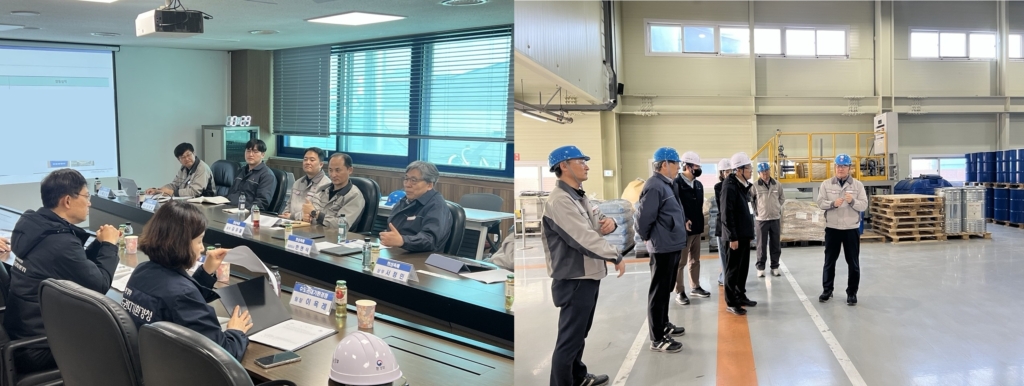
On March 25, Mr. Sangjin Lee, Head of the Metropolitan Air Quality Office under the Ministry of Environment of the Republic of Korea, visited Heesung Catalysts to conduct an on-site inspection of a facility participating in the voluntary fine dust reduction agreement program.
The visit was carried out as part of the 7th Seasonal Fine Dust Management Program, with the aim of reviewing the operation of environmental facilities and assessing ongoing efforts to reduce air pollutant emissions.
Review of Voluntary Agreement Implementation
The visit began with a company introduction followed by a discussion session.
During the meeting, Heesung Catalysts presented the current status of its voluntary agreement implementation and environmental facility operations, and shared its management strategies and operational approaches for reducing air pollutant emissions.
Since signing the voluntary fine dust reduction agreement with the Metropolitan Air Quality Office in November 2025, Heesung Catalysts has been actively carrying out emission reduction initiatives throughout the seasonal management period.
On-site Inspection of Production and R&D Facilities
The inspection continued with a review of environmental facility operations centered on the catalyst production lines. The delegation also visited the R&D facilities to observe the development and application processes of catalyst technologies.
Ongoing Efforts and Collaboration for Air Quality Improvement
This visit provided an opportunity to review both the implementation status of the voluntary agreement and the operation of environmental facilities, while also examining real-world applications of air pollutant reduction technologies in industrial settings.
It also highlighted the critical role of catalyst technologies in reducing air pollution and supporting carbon neutrality.
Heesung Catalysts will continue to contribute to air quality improvement through ongoing environmental management and technological innovation, while actively collaborating with relevant stakeholders to advance cleaner and more sustainable industrial practices.
